
From the story to daily life
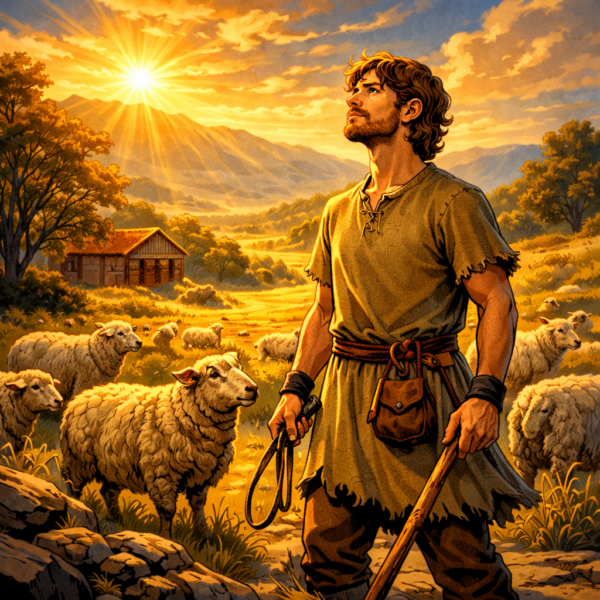
Seven sons had passed before Samuel. None was the one God had chosen. There was another son, Jesse explained, the youngest. David was still out looking after the sheep.
Story and reflection based on 1 Samuel 16, 1 Samuel 24 and 2 Samuel 5. The biblical events below are retold in our own words.
The son still with the sheep
God had sent Samuel to Bethlehem to anoint a king from Jesse’s family. When Samuel saw Eliab, he thought he had found the man. But God corrected him: appearance and height were not the measure. God looked at the heart (1 Samuel 16:6-7).
Then came the other brothers. Each time, the answer was no. Samuel asked whether all the sons were there, and the youngest was sent for. When David arrived, God identified him as the one to anoint. Samuel poured oil on him in front of his brothers, and the Spirit of the Lord came upon him.
It was a remarkable moment in an ordinary family’s life. Yet the chapter does not end with David on a throne. Saul was still king. When Saul later needed someone who could play music to bring him relief, David was recommended. The message to Jesse asked for the son who was with the sheep.
David entered Saul’s service and played his harp. He was close to the king, but he was there to serve. Being chosen by God had not made ordinary responsibilities disappear.
Chosen, but still waiting
The road ahead did not move smoothly from that anointing to a crown. Later, Saul pursued David with thousands of men. David and his companions sheltered deep inside a cave, and Saul entered without knowing they were there.
David’s men saw an opportunity. David cut a corner from Saul’s robe, then was troubled even by that act. He would not kill the man who was still the Lord’s anointed, and he restrained his companions. Afterwards, he appealed to God to judge between them (1 Samuel 24:4-15).
Here was faith during the unfinished part of the story. David placed his cause before God when he had an opportunity to settle it violently himself. His trust was taking shape in what he refused to do, as well as in what he did.
David eventually became king, first over Judah and later over all Israel (2 Samuel 5:1-5). But we should not hurry past the sheep, the service or the cave. Much of his story happened between being chosen and taking the throne.
Faith in the unfinished days
You may know something of that space between hope and what is happening now. You keep caring for someone, sending applications or doing work that receives little recognition. Other people’s lives seem to move forward while yours returns to the same responsibilities.
One way to receive David’s story is to let it turn your attention towards God in the life you already have. His kingship was a particular calling, not a promise that everyone who waits will gain a prominent role. Your next faithful action can matter without becoming the beginning of a success story.
Bring the disappointment honestly into prayer. Ask God to help you see what needs your care today. Keep a commitment, give a task your attention, or seek advice about a change you need to make. Trust does not require you to remain motionless. It can help you act responsibly without making recognition the measure of your worth.
Pause and reflect
Where is waiting wearing you down? What would it look like to bring that honestly to God and give one ordinary responsibility your care today, whether or not anyone notices?
A prayer for faith
God, You see what others may overlook. Help me trust You with the parts of my life that feel unfinished. Give me patience without passivity, honesty about disappointment, and wisdom for my next step. Teach me to care faithfully for what is before me, without needing praise to make it worthwhile. Amen.
