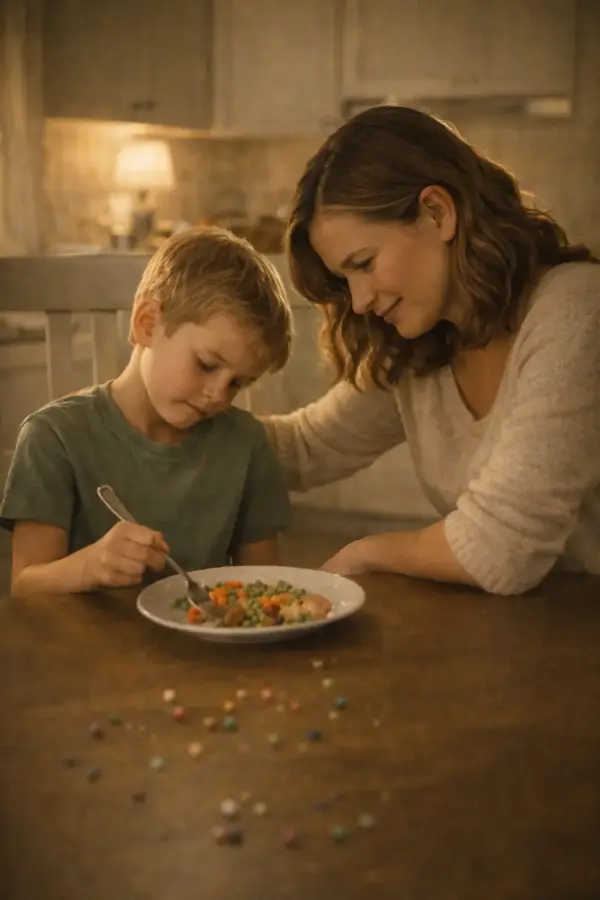

Your child is standing in the kitchen doorway holding the shattered remains of a friendship bracelet they just ripped off their wrist. Ten seconds ago they were furious at their sister. Five seconds ago they yanked the bracelet hard enough to snap the thread and send beads scattering across the tile floor. And now – right now – they are looking at the broken pieces in their hand with an expression you recognise instantly. It is not anger anymore. It is regret. Pure, wide-eyed, stomach-dropping regret. “I did not mean to break it,” they whisper. But they did break it. And they know it. And you know that no amount of restringing those beads will undo the feeling they have right now – the awful realisation that they acted before they thought, and now something they loved is in pieces on the floor.
You have seen this before. Different objects, different triggers, same pattern. The hasty word that wounds a friend. The homework ripped up in frustration and then cried over an hour later. The toy thrown across the room that breaks on impact. The decision made in the heat of the moment that they would give anything to take back. And every time, you find yourself thinking the same thing: how do I teach this child to stop – just for a second – and think before they act? How do I give them the thing that sits between impulse and action, the thing that catches the moment before it becomes a mess?
That thing has a name. It is wisdom. And it is one of the most valuable qualities a human being can possess – not because it makes life perfect, but because it makes life more deliberate. Wisdom is what allows a person to hold two truths at once: I am angry, and I do not have to act on my anger right now. I want this, and wanting it does not mean I should take it. Teaching wisdom to a child is not about making them cautious or timid or slow. It is about giving them the internal pause that turns reaction into response. And it starts much earlier than most parents think.
Why Impulsive Choices Are Not the Same as Bad Character
Before we talk about building wisdom, we need to clear something off the table. If your child acts impulsively – often, loudly, and in ways that leave a trail of broken things and hurt feelings – it does not mean they have a character problem. It means they have a brain that is still under construction. And the part of the brain responsible for impulse control, planning, and thoughtful decision-making is, quite literally, the last part to finish being built.
Dr. Daniel Siegel, clinical professor of psychiatry at UCLA and author of The Whole-Brain Child, has spent decades helping parents understand how the developing brain shapes behaviour. His research explains that the prefrontal cortex – the region behind the forehead that governs executive functions like planning, weighing consequences, and managing impulses – does not fully mature until the mid-twenties. In children, this area is particularly underdeveloped. When your seven-year-old throws a ball inside the house five minutes after you told them not to, they are not defying you. Their brain literally struggled to hold your instruction in working memory while the impulse to throw was firing. The wiring is not finished yet.
Dr. Adele Diamond, a neuroscientist at the University of British Columbia and one of the world’s leading researchers on executive function in children, has shown that the core executive functions – inhibitory control, working memory, and cognitive flexibility – develop gradually and unevenly throughout childhood. Her research, published in journals including Science and Annual Review of Psychology, demonstrates that these functions can be strengthened through practice, but they cannot be rushed. A child who struggles with impulse control at age five is not the same child they will be at age ten – provided they are given the right kind of support. Diamond’s work also shows that stress, lack of sleep, loneliness, and lack of physical exercise all impair executive function. So before you label your child’s impulsiveness as a discipline problem, check the basics. Are they sleeping enough? Are they moving enough? Are they under pressure that is too big for their age? Sometimes the most impulsive behaviour has the most ordinary cause.
This matters because the way you frame your child’s impulsiveness shapes the way they see themselves. If every hasty decision is met with “why did you do that?” or “you should have known better,” the child absorbs a message: I am the kind of person who does bad things. But if you can hold the truth that their brain is still growing – that impulse control is a skill, not a character trait – you can respond differently. You can say, “That did not go the way you wanted, did it? Let us talk about what you could do next time.” Same situation. Completely different message. And that message, repeated a thousand times over childhood, is what actually builds the foundation for wisdom.
What Wisdom Actually Looks Like in a Child
Most people confuse wisdom with intelligence. They are not the same thing. A child can be brilliant – top marks, sharp reasoning, advanced reading level – and still make spectacularly unwise choices. Intelligence is the ability to learn and process information. Wisdom is the ability to apply what you know in a way that accounts for consequences, other people, and the kind of person you want to be. Intelligence answers the question “can I do this?” Wisdom asks “should I?”
Dr. Robert Sternberg, a psychologist formerly at Yale and one of the most influential thinkers on intelligence and wisdom, developed what he calls the Balance Theory of Wisdom. His framework, published across multiple works including Wisdom, Intelligence, and Creativity Synthesized, defines wisdom as the application of intelligence and experience toward a common good – balancing your own interests with the interests of others and the broader context. Wisdom, in Sternberg’s model, is not about having the right answer. It is about weighing competing interests and choosing a course of action that serves something larger than your immediate desire. Even a young child can begin learning this. When a six-year-old decides to let their younger sibling go first because they can see the little one is about to melt down, that is wisdom in action. It is small. It is quiet. And it is the seed of something enormous.
Dr. Barry Schwartz, a psychologist at Swarthmore College and author of Practical Wisdom, argues that wisdom is not a fixed trait but a practical skill – the ability to do the right thing, in the right way, for the right person, at the right time. Schwartz emphasises that wisdom requires both the will to do good and the skill to figure out what “good” looks like in a specific situation. Rules alone are not enough. A child who follows rules perfectly but cannot navigate an ambiguous situation – where the rules conflict, or where the kind thing and the fair thing are not the same – is obedient, not wise. Wisdom is what fills the gap between rules and real life. It is judgment. It is discernment. And it grows through experience, reflection, and conversations with adults who take children’s moral thinking seriously.
So when you see your child pause before acting – when they consider how their choice might affect someone else, or when they choose the harder path because they know it is right – you are not just seeing good behaviour. You are seeing wisdom forming. Name it. “That was wise. You thought about it before you acted.” Children who hear that word attached to their choices begin to see themselves as people who are capable of wisdom. And identity is one of the most powerful engines of behaviour there is.
What the Bible Says About This
If there is one quality the Bible elevates above almost every other, it is wisdom. Not strength. Not success. Not even faith, in many passages. Wisdom. The book of Proverbs alone mentions it over a hundred times. And the way Scripture talks about wisdom is striking – it is not presented as an intellectual achievement but as a relational posture. Wisdom, in the biblical sense, is about how you orient yourself toward the world and the people in it.
The Hebrew word most commonly translated as “wisdom” in the Old Testament is chokmah. It appears over 150 times in the Hebrew Bible, and its meaning is richer than the English word suggests. Chokmah is not just head knowledge. It is skill in living. It includes craftsmanship, practical skill, the ability to navigate complex situations, and moral discernment. When Exodus describes the artisans who built the tabernacle, it uses the word chokmah to describe their ability – the same word used for Solomon’s legendary wisdom. The implication is clear: wisdom is not abstract. It is applied. It shows up in how you build things, how you make decisions, and how you treat people.
The most famous wisdom story in Scripture is Solomon’s request in 1 Kings 3. God appears to Solomon in a dream and says, essentially, “Ask for anything.” Solomon does not ask for wealth, military power, or long life. He asks for lev shomea – a “listening heart” or “discerning heart.” The Hebrew is beautiful and specific. Lev means heart – but in Hebrew thought, the heart is not just the seat of emotion. It is the centre of will, intention, and understanding. And shomea means to hear, to listen, to pay attention. Solomon asked for a heart that listens. Not a mind that knows everything, but a heart that pays attention – to people, to situations, to what is really going on beneath the surface. That is a profound model for what we are trying to build in our children.
Proverbs 2:6 says, “For the Lord gives wisdom; from his mouth come knowledge and understanding.” For families who hold faith at the centre, this verse grounds the pursuit of wisdom in relationship with God – wisdom is not something you manufacture, but something you receive. But even for parents who are not coming from a faith perspective, the insight holds: wisdom is not something children generate on their own. It comes from somewhere. It is passed down, modelled, offered. It comes from the mouth – from conversation, from storytelling, from a parent who sits with a child and helps them think through what just happened and what they might do differently. Whether you understand that source as divine or human, the mechanism is the same. Wisdom is relational. It is transmitted through connection.
Proverbs 4:7 adds this: “The beginning of wisdom is this: get wisdom. Though it cost all you have, get understanding.” There is an almost urgent simplicity to it. Wisdom is not a bonus. It is the starting point. It is worth pursuing even when it is costly – and for a child, it is costly. Pausing before you act costs you the thrill of the impulse. Thinking about someone else’s feelings costs you the satisfaction of being right. Choosing the harder path costs you the easy one. Teaching your child that these costs are worth it – that wisdom is the thing most worth having – is one of the most important things a parent can do.
What This Looks Like at Different Ages
Wisdom is not one thing. It looks different at every stage of development, and expecting the same kind of thoughtfulness from a five-year-old and a twelve-year-old will only frustrate you both. Here is what you are actually looking for – and what is realistic – at each stage.
Ages 4-6
At this age, wisdom looks like the very beginning of impulse control. A child who can wait three seconds before grabbing. A child who can sometimes use words instead of hands. A child who, after doing something they regret, can tell you what happened and what they wish they had done instead. This is not sophisticated moral reasoning. This is the earliest scaffolding of it – and it is huge. You will see it in small moments: they reach for a toy another child is holding and then pull their hand back. They start to shout and then stop themselves. They say “I wanted to hit but I did not.” These moments deserve celebration, because they represent enormous neurological effort for a brain this young. The prefrontal cortex is barely online at this age. Every moment of self-regulation is like lifting a weight that is almost too heavy. Narrate what you see. “You stopped yourself. That took real strength.” Do not expect consistency. They will manage it one day and not the next. That is normal and it is fine.
Ages 7-9
This is the age where wisdom starts to include other people. Children in this range are developing what psychologists call “theory of mind” in a more robust way – they can genuinely begin to imagine how someone else feels and factor that into their decisions. You will see it when your child says, “I was going to tell Mum, but I did not want to get him in trouble.” That is a child weighing two competing values: honesty and loyalty. They may not resolve it well every time, but the fact that they are weighing it at all is significant. At this age, you can begin asking wisdom questions after things go wrong. Not in the heat of the moment – later, when everyone has cooled down. “What were you trying to do? What actually happened? If you could rewind and do it again, what would you change?” These conversations, repeated over months and years, are the single most powerful tool for building wisdom. You are teaching your child to reflect – and reflection is the engine of wisdom. Without it, experience teaches nothing.
Ages 10-13
Pre-teens are capable of genuine moral reasoning, and they know it. This is the age where children begin to push back on rules not because they are defiant but because they are genuinely thinking about fairness, consistency, and whether the rules make sense. This can be exhausting for parents – but it is actually one of the most important signs of developing wisdom. A twelve-year-old who says “that is not fair” is not always being difficult. Sometimes they are making a legitimate moral observation, and the wise response is to hear them out. At this age, wisdom shows up as the ability to foresee consequences before acting. They can think two or three moves ahead. They can anticipate how a friend might react. They can weigh short-term fun against long-term trust. You will also see them making quiet moral choices that they do not tell you about – choosing not to join in when peers are being unkind, standing up for someone, deciding not to share a secret that was told in confidence. These choices are wisdom in its purest form, and you may never even know they happened. Trust that the work you have done is bearing fruit, even when you cannot see it.
Four Things to Try at Home
1. Build the pause into daily life. Wisdom lives in the gap between impulse and action, so practise creating that gap in low-stakes situations. Before your child answers a question at dinner, ask them to take one breath first. Before they choose what to watch, ask them to name two options and think for ten seconds. Before they respond to a sibling’s provocation, teach them to put their hands behind their back and count to three. These micro-pauses are not punishments and they are not about control. They are training the brain to create a space where a choice can live. Over time, the pause becomes automatic – and that is when wisdom starts to show up in the moments that matter.
2. Tell stories where wisdom wins and foolishness costs. Children learn moral reasoning through narrative far more effectively than through instruction. When you tell your child the story of Solomon asking for wisdom instead of wealth, they are not just hearing a Bible story – they are absorbing a value: that the wisest thing you can ask for is the ability to make good decisions. When you tell them about a time in your own life when you acted without thinking and regretted it, you are modelling vulnerability and reflection. When you read them a book where a character makes a thoughtful choice under pressure, stop and name it. “Did you see what she did there? She was scared, but she thought about it first. That is wisdom.” Stories do what lectures cannot. They get under the skin.
3. Ask “what do you think?” before you give advice. When your child comes to you with a problem – a conflict with a friend, a decision about school, a moral dilemma – resist the urge to solve it immediately. Ask them what they think first. “What do you think you should do?” or “What are your options?” or “What would happen if you did that?” This is not withholding help. It is building the muscle of discernment. When children practise evaluating options out loud, with a safe adult who listens, they learn to do it internally. Over time, they stop needing you to think it through with them – because you have taught them how to think it through themselves. That is the goal. Not a child who always makes the right choice, but a child who knows how to think about their choices.
4. Debrief after things go wrong – without shame. The richest wisdom-building moments are not the successes. They are the failures. When your child makes a poor choice – and they will, regularly, because they are children – the conversation afterward is where wisdom grows. But it only works if the conversation is safe. If debriefing always feels like a lecture or a punishment, your child will stop being honest with you. Instead, try this framework: “What happened? What were you feeling? What did you want to happen? What actually happened? What could you try next time?” These five questions, asked calmly and without judgment, teach a child to reflect on their own behaviour. That reflective capacity is not just a parenting tool. It is a life skill that will serve them in every relationship, every job, and every difficult decision they will ever face.
What to Do When It Keeps Not Happening
“We have talked about this a hundred times and nothing changes.” Repetition is not failure. It is how the brain learns. Dr. Adele Diamond’s research shows that executive function skills require extensive practice in varied contexts before they become reliable. If your child can pause and think before acting in one setting but not another, that is not stubbornness – it is how skill transfer works. It takes time. Keep going. The hundred-and-first conversation is still doing something, even when it does not feel like it.
“My child seems to understand but then does the same thing again.” Understanding and doing are different brain systems. Knowing the right thing to do requires the prefrontal cortex. Actually doing it in the moment – when emotions are high and impulses are firing – requires a level of self-regulation that develops slowly. Your child is not being hypocritical when they explain exactly what they should have done and then do the opposite next time. They are being a child. The gap between knowing and doing narrows with age, practice, and a patient adult who does not give up on them.
“I am starting to wonder if there is something more going on.” Trust your instincts. If your child’s impulsiveness is significantly more intense, more frequent, or more disruptive than what you see in their peers – and if it is affecting their friendships, their learning, or their wellbeing – it is worth having a conversation with their teacher and potentially a developmental paediatrician. Conditions like ADHD affect executive function directly, and they are not character flaws. They are neurological differences that deserve support, not shame. Getting an assessment is not labelling your child. It is understanding them better so you can help them more effectively.
“I am not exactly a model of wisdom myself.” Good. Seriously – that awareness is itself a form of wisdom. Your child does not need a perfect parent. They need an honest one. If you lose your temper and then come back later and say, “I reacted too fast. I wish I had paused before I said that. I am sorry,” you are modelling exactly what you are trying to teach. You are showing them that wisdom is not about never making mistakes. It is about what you do after the mistake. That kind of modelling is worth more than a thousand calm, measured lectures. Let them see you being human. Let them see you trying to be better. That is the curriculum.
The Deeper Thing
There is a reason Solomon’s story does not end with his famous request for wisdom. It would be a neater story if it did – young king asks for the right thing, gets it, and lives well. But the Bible does not do neat stories. Solomon receives extraordinary wisdom. He rules with discernment. He builds the temple. He writes proverbs that people are still reading three thousand years later. And then, slowly, over time, he drifts. He accumulates wealth and power. He marries strategically. He compromises on the very principles he once articulated so clearly. By the end of his life, the wisest man who ever lived has become a cautionary tale about how wisdom can be given, received, and then gradually abandoned.
That story matters because it tells us something essential about the nature of wisdom: it is not a one-time acquisition. It is a daily practice. You do not get wise and then stay wise automatically. Wisdom requires maintenance. It requires humility – the ongoing willingness to admit that you do not have all the answers and that your understanding might be incomplete. It requires relationships – people around you who will tell you the truth even when it is uncomfortable. And it requires attention – the discipline of paying attention to your own life, your own choices, and the gap between the person you want to be and the person you are actually being.
This is what makes wisdom different from intelligence. Intelligence is a capacity. Wisdom is a relationship – with reality, with other people, and for those who hold faith, with God. It is not something you possess. It is something you practise. Solomon’s story is both a gift and a warning: wisdom is available to anyone who asks for it, but holding onto it requires the kind of daily humility that even the wisest among us can lose. When you are raising a wise child, you are not installing software that runs forever. You are building a habit of attention, reflection, and care that they will need to maintain for the rest of their lives. The good news is that every conversation you have with them about choices, consequences, and character is a deposit in that account. The habit of reflection, once formed, is remarkably durable. You are not building something fragile. You are building something that will hold.
One Thing to Sit With
Think about the last time you reacted before you thought. Not your child – you. The sharp word. The snapped response. The decision made in frustration that you wished you could take back. Think about what was driving that moment. Were you tired? Overwhelmed? Carrying something that had nothing to do with the situation in front of you? Now think about what it would have taken to pause – just for two seconds – before you spoke or acted. That pause is the same one you are trying to teach your child. It does not come naturally to you either. Wisdom is not a destination any of us arrive at. It is a direction we keep choosing, day after day, in small moments that nobody sees. You are asking your child to do something genuinely difficult. Let that make you gentle with them. And let it make you gentle with yourself.
Further reading: The Whole-Brain Child by Dr. Daniel Siegel and Dr. Tina Payne Bryson. Practical Wisdom by Barry Schwartz and Kenneth Sharpe. How Children Succeed by Paul Tough.
Looking for more faith-filled stories? Browse the full library of Bible heroes for kids at Faith Force. For a verse to anchor this conversation, read Proverbs 2:6 on Bible Gateway.