
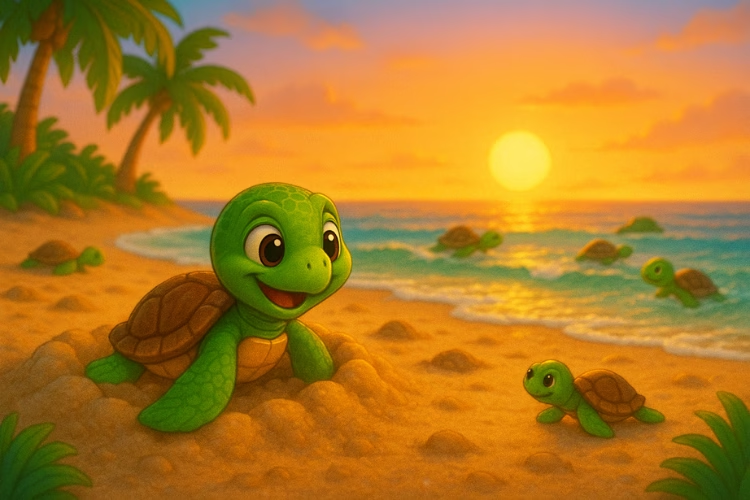
My kids wanted to know why the sea turtle in the aquarium kept swimming the same circuit over and over – around and around the tank, steady, unhurried, like it had already mapped the whole route and was simply executing it for the ten thousandth time. “Does it ever get tired?” my younger one asked. The docent smiled. “They are built for long journeys,” she said. “They do not really have a gear for giving up.” My daughter chewed on that for a while. On the drive home she said: “I want to be built like that.” I think she meant it.
There is a kind of endurance that is not grim or white-knuckled. The sea turtle has it. And it is worth understanding where it comes from.
What Sea Turtles Can Teach Us
Sea turtles have existed on earth for approximately 110 million years. They outlived the dinosaurs. They have navigated mass extinction events, ice ages, and millennia of oceanic change, and they are still doing the same thing their ancestors did – swimming their routes, returning to their beaches, nesting with extraordinary fidelity to the places where they were born. A female sea turtle will return to the exact beach where she hatched to lay her own eggs, sometimes after spending decades at sea, navigating by the earth’s magnetic field with a precision that scientists are still working to fully understand. She was not taught to do this. It was encoded into her at birth.
Loggerhead sea turtles migrate up to 8,000 miles between their feeding grounds and nesting beaches. Leatherback sea turtles have been tracked traveling more than 12,000 miles in a single migration – the longest known migration of any reptile on earth. They do this in open ocean, without landmarks, without a flock to follow, without any external confirmation that they are going the right direction. The route is internal. The commitment is absolute. They do not turn back halfway.
The sea turtle’s pace is part of what makes its perseverance possible. It is not fast. It is steady. Leatherbacks have been clocked at 22 miles per hour in short bursts, but their migrations are accomplished at a sustained, sustainable pace – not a sprint, not even a race. They outlast. Where other creatures might burn bright and brief, the sea turtle simply continues. One stroke at a time. One day at a time. Ten million years of one day at a time.
God built into the sea turtle a picture of what long obedience looks like: not spectacular, not dramatic, not fast – but faithful, directional, and grounded in something encoded so deeply that no external confusion can override it. The sea turtle knows where home is. It keeps swimming toward it. That is the entire testimony.
The Biblical Mirror
Eugene Peterson coined the phrase “a long obedience in the same direction” to describe what the Christian life actually requires – not a single dramatic commitment, but a sustained, directional movement that continues through decades of ordinary days, hard seasons, confusing stretches, and the deep temptation to stop. Hebrews 12:1 uses the image of a race: “Let us run with perseverance the race marked out for us.” The Greek word for race here is “agon” – from which we get the word agony. It is not a sprint. It is a marathon. The instruction is not to run faster. It is to run with perseverance.
Abraham is the great sea turtle of scripture. God called him at seventy-five years old, promised him descendants as numerous as the stars, and then waited. And waited. And Abraham kept moving – not always perfectly, not without detours (the Hagar situation is not a high point) – but he kept going. Isaac was not born until Abraham was one hundred years old. Twenty-five years of swimming the same direction with no visible evidence that the beach was getting any closer. Hebrews 11:8-10 says he was “looking forward to the city with foundations, whose architect and builder is God.” He was navigating by something encoded inside him – a calling that was more reliable than what he could see.
Romans 5:3-4 describes the sea turtle’s logic in theological terms: “We also glory in our sufferings, because we know that suffering produces perseverance; perseverance, character; and character, hope.” The long miles are not just the cost of the destination. They are producing something in the swimmer. The sea turtle that crosses 12,000 miles of open ocean is not the same creature it was when it left. Neither is the person who has kept faith through decades of ordinary, unseen, unmeasured faithfulness. The perseverance itself is forming something that no shortcut can produce.
For Your Kids
Ages 5-7
Young children give up on things quickly – that is developmentally normal, and it is not a character failure. What you can do at this age is begin building the habit of “one more try” and the language of continuing. “The sea turtle swims all the way across the ocean without stopping. It does not give up even when it cannot see the beach yet. Can you try one more time?” Name specifically when you see them persevere – not just praise the result, but praise the continuation: “I saw you keep trying even when it was hard. That is the sea turtle in you.” That kind of specific observation builds the identity of a perseverer before the harder tests come.
Ages 8-10
At this age, kids encounter real tasks that require sustained effort over time – learning an instrument, mastering a skill, finishing a long project, maintaining a difficult friendship. The sea turtle’s steadiness is the right image for this. “The turtle does not go faster when it gets tired. It just keeps the same pace. What would it look like to keep your pace even when you feel like slowing down or stopping?” Talk about the magnetic field navigation – the sea turtle trusts something internal, encoded at birth, even when there are no external landmarks to confirm it is on the right track. “What is the internal compass God has put in you – the thing you know is right even when everything outside is confusing?”
Ages 11-13
Preteens are beginning to understand that life is long and that the things that matter most take years to build. This is also when quitting begins to feel like a rational option – when the cost of continuing seems higher than the cost of stopping. Hebrews 12:1-2 is a powerful text for this age: “fixing our eyes on Jesus, the pioneer and perfecter of faith.” The sea turtle navigates by an encoded signal. The believer navigates by keeping Jesus in view. Ask your preteen: “What is one thing you are in the middle of that requires long obedience? What would it mean to fix your eyes on Jesus in that specific situation – not to get to the destination faster, but to keep going in the right direction?” Help them see that perseverance is not suffering through something miserable. It is trusting, one day at a time, that the direction is right.
This Week’s Challenge
One Action
Pick one thing each family member has been tempted to give up on – a skill, a habit, a relationship, a spiritual practice – and commit to one more week of faithful continuation. No dramatic overhaul. Just one more week of showing up. The sea turtle does not revolutionize its strategy. It keeps swimming. Report back in seven days.
One Conversation Starter
Sea turtles navigate by the earth’s magnetic field – an internal compass that was encoded in them at birth. They never question whether the direction is right. They just follow it. What is your internal compass – the deep, encoded sense of direction that you know is right even when nothing external confirms it? How do you keep that compass calibrated?
One Verse
“Let us run with perseverance the race marked out for us, fixing our eyes on Jesus, the pioneer and perfecter of faith.” – Hebrews 12:1-2
Family Activity
Create a family “Long Obedience Map.” On a large piece of paper, draw a simple ocean map with a starting shore and a distant beach. Each family member marks where they are in one long journey they are on – it could be a faith journey, a skill they are building, a relationship they are investing in, a character quality they are developing. Mark the starting point, where you are now, and where you believe the beach is. Talk about the waters in between – what is turbulent, what is unknown, what is calm.
Then pray over each person’s journey and discuss these questions:
Discussion Starters
- Sea turtles have been doing this for 110 million years – crossing the same oceans, returning to the same beaches. What is something worth doing for the rest of your life, even if it is never finished in your lifetime?
- Abraham waited twenty-five years for the promise God made him. When have you been in a long waiting season? How did you stay oriented when there was no visible progress?
- Romans 5 says suffering produces perseverance, which produces character, which produces hope. Looking back, can you trace that sequence in something you have been through? What character did the long miles produce in you?
- The sea turtle crosses 12,000 miles alone – no flock, no guide, just the internal compass. But we are designed for community, not solo migration. Who swims alongside you? Who is swimming a long journey that you could join?
- What would you do differently if you stopped expecting the journey to be short?
A Prayer to Close
Father, You are the One who finishes what You start – the pioneer and perfecter of our faith. Thank You that You do not abandon us in the middle of the crossing. Thank You for the sea turtle’s testimony: that long obedience in the same direction is possible, that the internal compass holds, that the beach is real even when it is not visible. Teach our family to keep swimming – not to go faster than we are able, not to measure our progress against anyone else’s, but to keep moving in the direction You have encoded in us. Fix our eyes on Jesus. Keep our compass calibrated. And on the days we cannot see the shore, remind us that You can. Amen.
One Last Thing
My daughter said she wanted to be built like that – like a sea turtle, without a gear for giving up. I told her the good news: she already is. God built the capacity for that kind of perseverance into every person He made. The sea turtle accesses its by instinct. We access ours by faith – by fixing our eyes on Jesus, by trusting the internal compass that the Holy Spirit provides, by showing up one more day when everything in us wants to stop.
The race marked out for you is not marked out for anyone else. The specific shape of your long obedience is yours alone. But the One who marked it out is also the One running it with you. You are not crossing the ocean alone. And the beach is real. Keep swimming.