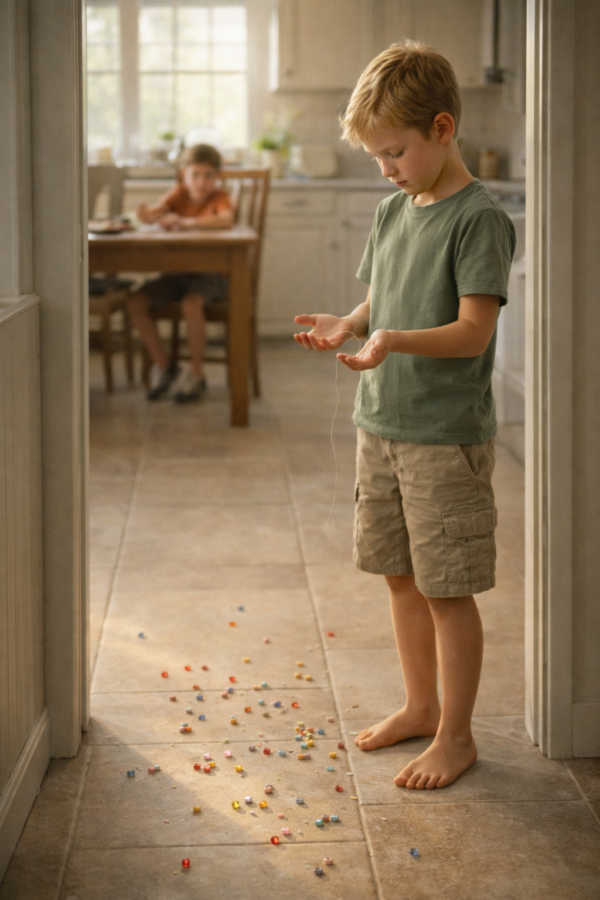
Screen time for kids is one of the most common struggles families face today – and the guilt that comes with it can feel almost as heavy as the screen itself. You know the moment. You ask them to put it down – the tablet, the phone, the controller – and what comes back feels completely out of proportion. A meltdown. Tears. A slammed door. Or maybe it is not that dramatic. Maybe it is the glazed eyes. The child who was cheerful and chatty two hours ago is now irritable, restless, and unable to settle into anything else. Or maybe it is the quieter version – the one that creeps in slowly. The child who has stopped drawing. Stopped building. Stopped going outside unless you make them. Stopped being bored, because the screen fills every gap before boredom has a chance.
And then comes the guilt. Because you handed it to them. Because you needed twenty minutes to make dinner. Because the car journey was long. Because it was easier. Because you were exhausted and the screen bought you a little peace. We are not here to judge that. Many parents recognise this situation. This is not a lecture about what you should have done. This is a practical guide to what you can do now – honestly, calmly and without pretending there is one perfect formula.
What the Research Actually Says
There is a lot of noise about screen time. Headlines swing between “screens are destroying a generation” and “screen time panic is overblown.” The truth sits in a more careful place. Screen use is not all the same, and the evidence is not helped by fear. But it is worth knowing what the research and current paediatric guidance actually say.
Psychologist Jean Twenge and colleagues have reported associations between higher daily screen use and lower psychological well-being in children and adolescents. That research is observational, and it is debated. Associations do not prove that screens caused the outcomes being measured. Still, the pattern is worth taking seriously, especially when heavy screen use is linked with less sleep, less movement, less face-to-face connection or more exposure to stressful online spaces.
A frequently cited Pediatrics study on fast-paced cartoons found a short-term effect in four-year-olds: after nine minutes of a fast-paced cartoon, children performed worse on executive-function tasks than children in comparison groups. That does not prove that every fast-paced show rewires a child’s brain, and it does not explain every screen-related struggle. It does suggest that content style and pacing may matter, especially for younger children whose self-regulation skills are still developing.
The American Academy of Pediatrics updated its digital-media guidance in 2026. The emphasis is no longer simply “count the hours.” Families are encouraged to look at the child, the content, whether screens are being used mainly for calming, what screen use is crowding out, and how openly the family communicates about media. A child video-calling a grandparent is not the same as a child passively scrolling short-form video. A child watching a nature documentary with an adult nearby is not the same as a child alone with autoplay.
That last point is often the most useful one. The concern is not only what the screen is doing. It is also what screen use may be replacing. Sleep can be displaced. Physical activity can be displaced. Face-to-face interaction can be displaced. Reading, boredom, outdoor play and quiet imagination can be displaced. A more useful question may be: “Can my child regulate around screens, and is screen use displacing sleep, movement, relationships or other important activities?”
Why Removing the Screen Alone May Not Solve the Problem
Sometimes removing a device is necessary. If a child is viewing harmful content, being bullied, sharing unsafe information or using a device in a way that puts them at risk, a parent may need to step in immediately. Safety comes first.
But in everyday screen-time struggles, simply taking the device away often does not build the skill your child needs next. It may stop the behaviour for the moment, but it may not teach a child how to transition, tolerate boredom, handle disappointment or choose something else. Restriction without replacement can become a power struggle: the screen becomes the prize, the parent becomes the blocker, and the real lesson gets lost.
The goal is not necessarily a screen-free home. The goal is a child who can grow in self-control – who can put the device down, transition to something else, and still feel steady without it. That is a skill, not a personality trait. Like most skills, it is built slowly with practice, structure and support.
A practical framework that helps many families comes down to three things: boundaries, alternatives and involvement.
Boundaries work best when they are clear, consistent and decided in advance. A calm rule set before the difficult moment usually lands better than a rule shouted during a meltdown. “Screens stay out of bedrooms overnight” is a boundary. “Give me that right now” may be necessary sometimes, but it is a reaction. Children may push against both, but predictable structure gives everyone a better chance of staying calm.
Alternatives matter. If the screen disappears and nothing else is visible, accessible or appealing, many children will fight to get it back. The gap needs to be filled – not by a parent entertaining them every second, but by a home rhythm where other options are easier to choose. Art supplies on the table. A ball by the door. Books within reach. A short movement break after a show. Space for boredom. Boredom is uncomfortable, but it can also be where creativity starts.
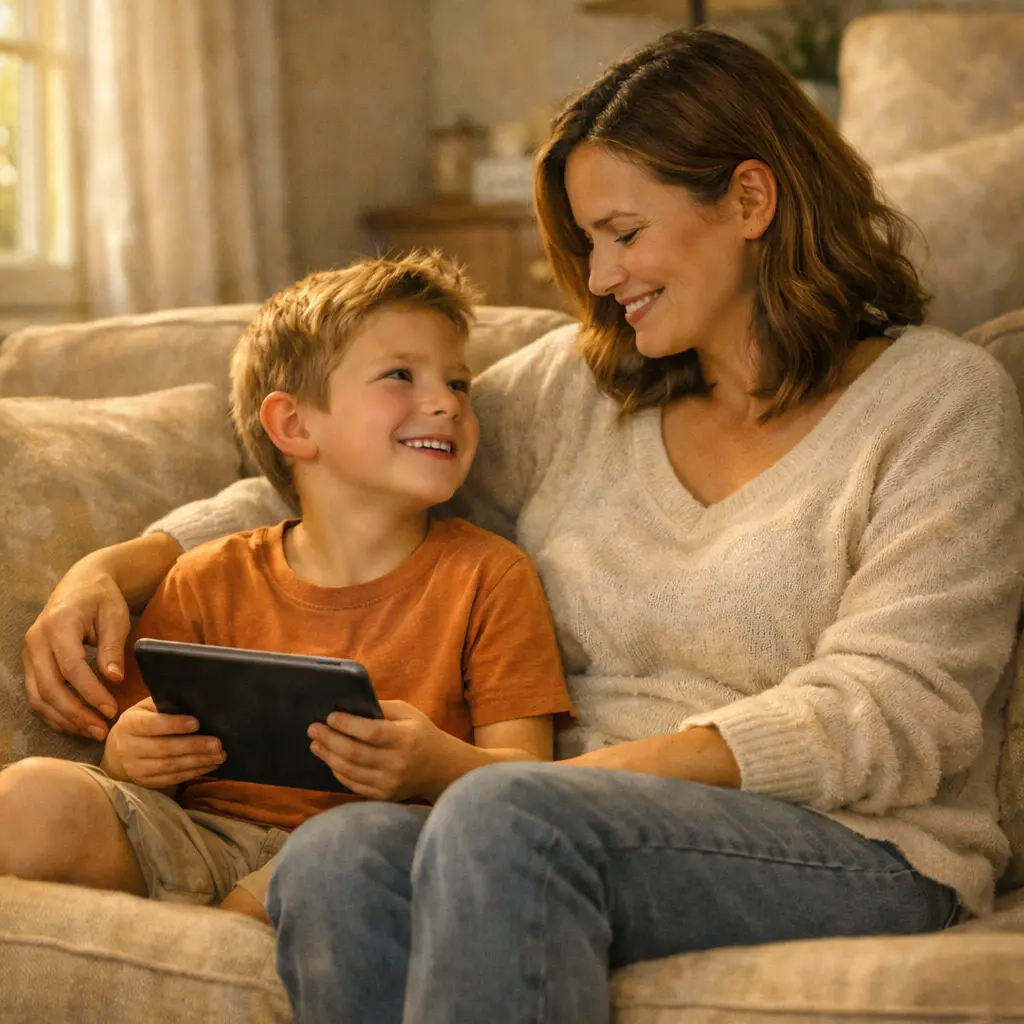
Involvement changes the tone. Watch with them when you can. Play the game with them. Ask about the channel they love. Talk about what they are seeing and hearing. Co-use does not make every piece of media healthy, but it gives you a window into your child’s digital world and helps your child practise discernment with you nearby.
What the Bible Says About This
Scripture was written long before smartphones, tablets and streaming platforms. But the wisdom in it speaks directly to how we use our time, what we allow to shape our hearts and how we build rhythms that keep us grounded.
Ephesians 5:15-16 says: “Be very careful, then, how you live – not as unwise but as wise, making the most of every opportunity.” That is not a guilt trip. It is an invitation to be intentional. Childhood is not something to panic over, but it is something to steward. The hours our children spend are forming habits, memories, attention and character.
Proverbs 4:23 says: “Above all else, guard your heart, for everything you do flows from it.” What enters a child repeatedly can shape what they see as normal, desirable or funny. Guarding the heart is not about fearfully blocking every possible influence. It is about paying attention to the door: what is being watched, what is being repeated, what is being rewarded, and how your child responds afterwards.
The Sabbath principle also matters here. Scripture teaches a rhythm of stopping, resting and remembering that we are not made only for production or consumption. Screens can fill every pause. Intentional offline time – for adults as well as children – makes room for prayer, conversation, play, silence and presence. This is not legalism. It is wisdom for a family learning to live with attention and love.
These are not rules to make you feel like you are failing. They are biblical anchors for a modern problem: be wise with time, guard the heart, and build rhythms that leave space for God, family, rest and real-life practice.
What This Looks Like at Different Ages
Knowing the principles is one thing. Knowing what to do on a Wednesday afternoon with a whining six-year-old is another. Here is what this can look like in practice, broken down by age.
Ages 4-6
At this age, screens should usually be one activity among many, not the default activity everything else revolves around. Habits are forming quickly, and the pattern you set now can become the baseline your child expects.
Co-watch when you can. Sit with them. Ask questions: “Why do you think that character did that? What would you do?” This turns some passive viewing into a more active conversation and helps you notice how your child processes what they see.
When screen time ends, plan the transition. “The show is done – now we are going outside for ten minutes” will often work better than a sudden demand with no next step. Movement, food, a simple job or a parent-child activity can make the shift easier for many children.
Protect the last hour before bed as much as you can. AAP guidance encourages families to avoid screens before bed and keep devices out of bedrooms overnight. Sleep affects mood, attention and self-control, so bedtime is one of the most valuable places to hold a boundary.
Ages 7-9
This is the age where you can start building self-regulation, not only imposing rules from the outside. Some families use a simple screen budget: a planned amount of recreational screen time for the week, with guidance from the parent and limited choices for the child. The point is not to hand over control too early. The point is to help the child notice that choices have consequences.
Start building internal awareness. After screen time, ask simple questions: “How do you feel right now? Do you feel different than when you started? How do you feel after playing outside compared with watching videos?” You are not forcing the right answer. You are helping your child notice patterns in their own body and mood.
This is also a good age for a family media agreement. Write it together. Put it somewhere visible. Include screen-free times, approved apps, what to do if they see something uncomfortable, and what your family values around media are. When children help shape a rule, they may be more likely to understand it and remember why it exists, even though parents still carry the responsibility for the final boundary.
Ages 10-13
This is where it gets harder. Social pressure grows. Group chats, games and social platforms can make a child feel left out if they are not constantly available. Dismissing that feeling does not help. Acknowledge it: “I understand this feels big. Let us talk about it.” Then keep the boundary where the boundary needs to be.
Monitor with honesty. Parental controls may be appropriate, especially for younger children or new devices, but secret surveillance can damage trust. The better long-term goal is regular conversation: “What are people posting about? Is anything online making you feel bad about yourself? What do you do when you see something that bothers you?” These conversations need to happen often, not only after something goes wrong.
Establish phone-free zones and times. Meals are phone-free for everyone. Bedrooms are phone-free overnight. The first hour of the morning may be phone-free. These are not arbitrary restrictions. They protect connection at the table, sleep at night and a calmer start to the day.
Model it yourself. Children notice adult phone habits. If we scroll during dinner, check notifications during conversations or reach for the phone during every quiet pause, they learn from that. You do not have to be perfect. But honesty helps: “I struggle with this too, and our family is going to practise better habits together.”
If you are reading this, you are already paying attention. That matters. There is no perfect app or perfect rule that replaces the slow work of presence, boundaries and conversation. Some days will be messy. Some rules will need adjusting. But steady practice is still practice.
The goal is not a screen-free childhood. Screens are part of the world your child is growing up in, and pretending otherwise does not prepare them for it. The goal is a child who can put the device down and still know who they are without it. A child who can be bored and let something creative rise out of the silence. A child who can sit at a table and hold a conversation. A child who sleeps well, plays hard and learns to lift their eyes toward what matters.
You are building that one boundary at a time, one conversation at a time, one evening with the screens off and the family together at a time. For a verse to anchor this conversation, read Philippians 4:8 on Bible Gateway.
This guide provides general educational information and is not a substitute for individual advice from a qualified health or child-development professional.
Sources and Further Reading
- American Academy of Pediatrics - A Child-Friendly Digital World: AAP Releases New Media Recommendations
- American Academy of Pediatrics - Helping Kids Thrive in a Digital World: AAP Policy Explained
- American Academy of Pediatrics - Family Media Plan
- American Academy of Pediatrics Center of Excellence - Screen Time Affecting Sleep
- Lillard AS and Peterson J - The Immediate Impact of Different Types of Television on Young Children's Executive Function
- Twenge JM and Campbell WK - Associations between screen time and lower psychological well-being among children and adolescents