
Mission Briefing
There is no light at the bottom of the sea. There is no sound except water and the slow movement of something enormous around you. Three days. No way out. No way forward. Nothing to do and nowhere to go except back toward the thing you ran from. Jonah had done everything right by his own logic – he had a reason, he had a plan, he had a ship headed in the right direction. And here he was anyway, in the dark, inside a fish, completely out of moves. Sometimes that is where the real prayer happens. Not the polished kind. The kind that starts: in my distress I called to the Lord, and He answered me.
Mission Verse
“In my distress I called to the Lord, and he answered me.” – Jonah 2:2
Repentance does not start with having the right words. It starts with turning toward the only one who can actually help.
Mission Briefing
God gave Jonah a clear assignment: go to Nineveh, the capital city of the Assyrian empire, and preach against it. Nineveh was not a pleasant posting. The Assyrians were the most feared military power in the ancient world – brutal, effective, and notorious for what they did to conquered peoples. Jonah knew the city. He knew what it represented. And he knew, if he is honest, what he was afraid of: not that he would fail, but that he would succeed. That God would show mercy to people Jonah believed deserved none.
So Jonah ran. He went to the port at Joppa, paid his fare, boarded a ship to Tarshish – the farthest point west on any map he knew – and went below deck. The plan was clean. Except God sent a storm unlike anything the sailors had seen, and twelve experienced men were on their knees praying to every god in their vocabulary, and the prophet was asleep. When the captain woke him, when the lot fell on Jonah, when every man on that ship turned and stared at him – he told them the truth. I am a Hebrew. I worship the Lord, the God of heaven, who made the sea and the dry land. Throw me overboard, he said. The storm is mine. They tried everything else first. When there was nothing left to try, they threw him in. The sea went still immediately.
The fish was waiting. The text says God appointed it – that word matters. This was not an accident. It was sent. It swallowed Jonah whole and carried him for three days. Three days in total darkness, in the belly of something living, at the bottom of the ocean. No rescue. No exit. Just Jonah and the dark and the slow understanding of where his running had brought him.
And then he prayed. The prayer in Jonah chapter 2 is worth reading slowly. It is not smooth. It borrows language from the Psalms – phrases Jonah had known since childhood – but the feeling underneath them is entirely real. He describes sinking. Water closing over his head. Seaweed wrapping around him. The sense of being cut off from everything. And then: when my life was fainting away, I remembered the Lord. That is the turn. Not a resolution. Not a plan. Just a turn – back toward the one he had been running from. The fish vomited him onto dry land. He was alive. He was back.
God’s second word to Jonah was identical to the first: go to Nineveh. Same city. Same assignment. Nothing had changed about the mission. Everything had changed about Jonah. He went. He walked into the city and preached one message. Forty days, and Nineveh will be overthrown. That was it. And the entire city – from the king on his throne to the cattle in the fields – put on sackcloth and fasted and turned from their violence. God relented. The city was not destroyed.
Jonah was furious. He sat outside the city walls and sulked and told God he had known this would happen – that God was too gracious, too slow to anger, too willing to relent. God grew a plant overnight to shade him. Jonah was glad about the plant. God let it wither by morning. Jonah was angry about the plant. And God asked the question that ends the book: you care about this plant, which you did not make or tend. Should I not care about Nineveh – a city of 120,000 people? Jonah never answers. The book ends. The question hangs in the air, addressed to every reader who has ever decided someone else did not deserve another chance.
Repentance is not about being sorry enough or suffering enough. It is about turning around. You can turn around from inside a fish. You can turn around from anywhere.
Your Child and This Moment
Your child is not going to be swallowed by a fish. But they are going to run from something. Every child does – a hard conversation, a wrong they made, a responsibility they did not want, a moment where the right thing felt impossible. The shape of the running will look different but the logic is identical: if I go far enough, fast enough, maybe this will not be mine to deal with. Jonah’s story does not shame the running. It tells the truth about where it ends – and more importantly, about what happens when you turn around. You turn around. God sends you again. The assignment is still there. So is the help.
Repentance is one of those words that can sound heavy, but the thing it describes is beautifully simple: you were going one direction, and now you are going another. That is it. A child who snatched a toy and now goes to give it back is practicing repentance. A child who lied and then tells the truth is practicing repentance. A child who has been unkind and then goes to say sorry is practicing repentance. None of these require suffering as a precondition. Jonah did not need to spend more time in the fish – he needed to turn around. The fish was just the place where the turning happened. Help your child see: the turning is always available. You can pray from inside a fish. God hears from there too.
And do not skip the ending. Jonah sulking under the plant is the most honest part of the whole story. He obeyed. He completed his mission. And he still had not fully learned the lesson. That is allowed. Repentance is not always a single clean moment that fixes everything. Sometimes it is a turn, and then another turn, and then another. God did not give up on Jonah because Jonah was still working through his feelings. God asked a question and waited. Your child does not need to get it all right at once. Neither did Jonah.
Put It Into Practice
- Name the Running. Ask your child: is there anything you have been putting off, avoiding, or pretending is not there? Not to create guilt – just to name it. Sometimes running looks like ignoring, delaying, or keeping very busy. Give it a name together. Then ask: what would turning around look like?
- Practice the Turn. When your child does something wrong – and they will, because children are children – make the repair as easy as possible. Help them say the words. Walk through the apology with them. Let them feel how fast the air clears after a real turning. That feeling is the lesson. Repentance is not a punishment. It is the way back.
- Read the Prayer. Read Jonah 2 aloud together – the actual prayer from inside the fish. Point out that it is not pretty or polished. It is a person in the worst moment of their life talking to God with whatever words they had. Tell your child: this is what prayer can sound like when things are really hard. You do not have to have the right words. You just have to turn and talk.
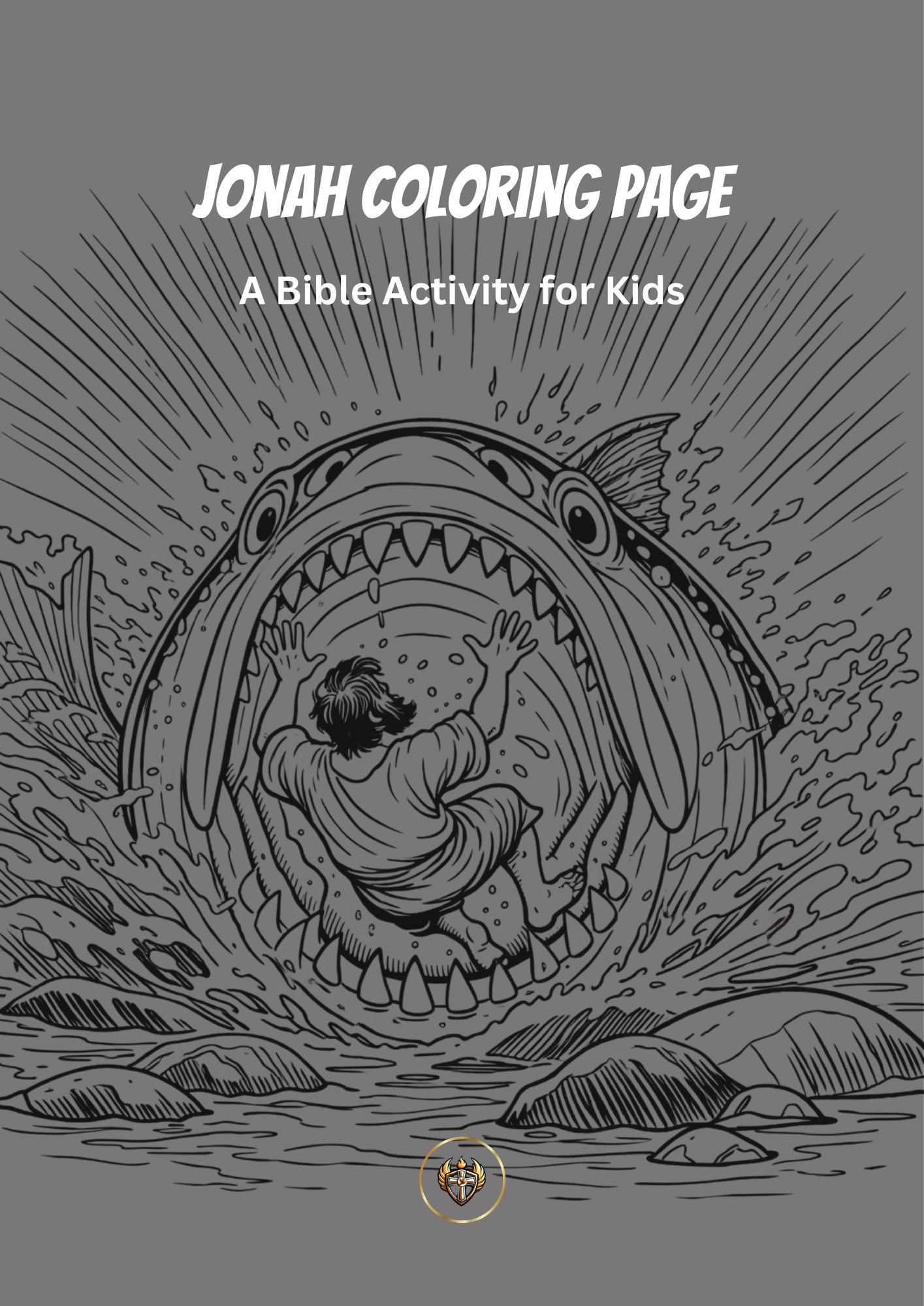
Get the free printable coloring page →
Hero Mission Activity – The Three-Day Letter
Jonah had three days in the fish with nothing to do but think. Give your child a piece of paper and a quiet ten minutes. Ask them to write or draw two things: one thing they have been running from (it can be small – the point is the honesty), and one thing they want to say to God about it. No rules about what it has to look like. It can be a single word, a picture, a sentence.
When they are done, let them choose: keep it private, share it with you, or pray it together out loud. The point is not the paper. The point is the turn.
Talk about it together:
- Ages 4-6: Jonah ran away instead of doing what God asked. Have you ever not wanted to do something you knew you should do? What happened? What does saying sorry feel like?
- Ages 7-9: Jonah prayed to God from inside a fish – a really dark, scary place. Do you think God still heard him? Is there anywhere you think God cannot hear you?
- Ages 10-13: Jonah did the right thing in the end but was still angry about it. Is it possible to obey and still have a bad attitude? What do you think God was trying to teach Jonah at the very end of the story, with the plant?
This week’s challenge: If there is something you have been avoiding or running from – even something small – take one step toward it this week. Tell someone in your family what the step was.
Mission Prayer
Jonah prayed from the darkest place he had ever been, and God heard him. You can pray from anywhere too – from a good day or a hard one, from the middle of getting it right or the middle of getting it wrong.
“God, thank You that You are the God of second chances. Help us turn back to You when we run – and trust that You are always ready to send us out again. Amen.”
♥ Mission Prayer
Dear God, thank You for always hearing us when we call out to You. Help us to be brave enough to say sorry when we get things wrong, and to turn back to You quickly. Just like Jonah, we want to get back on the right path. Amen.