
How to Create a Home Where Your Child Can Be Themselves
How to Create a Home Where Your Child Can Be Themselves
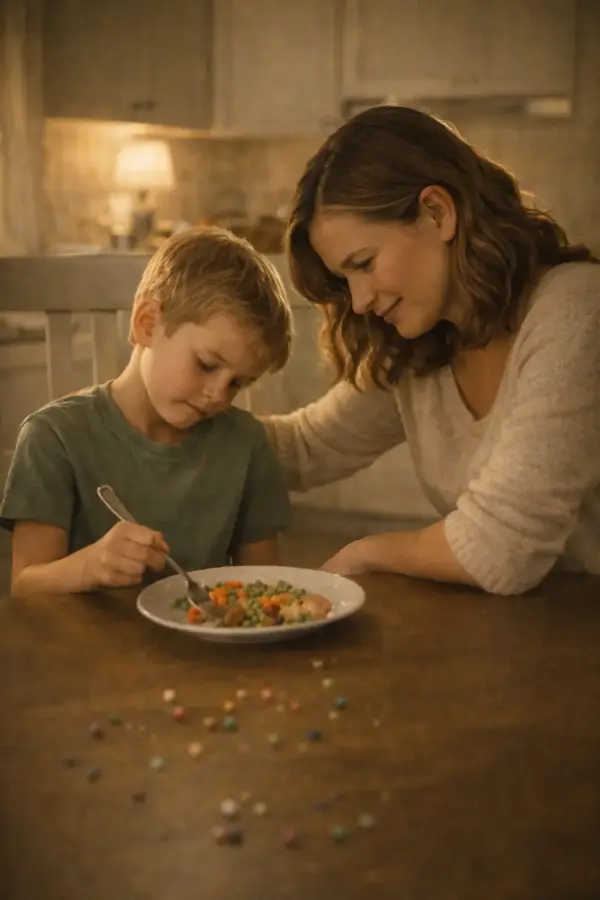
It is a Tuesday evening and your son is sitting at the kitchen table, not eating. He is pushing pasta around his plate with his fork, making small circles, and you know something happened today but he is not talking. You ask once, gently. He shrugs. You ask again. He says “nothing.” You let it go. Then, forty-five minutes later, when you are folding laundry on the couch and he is pretending to read, he says it – quietly, almost to himself. “Mum, do you think I am weird?” You stop folding. You look at him. He is not looking at you. He is looking at the book, but his eyes are not moving. He is waiting. And everything in this moment depends on what you do next. Not what you say – what you do. Whether your face changes. Whether your body tenses. Whether you rush to reassure or whether you sit down next to him and let the question breathe. Because what your son is actually asking is not whether he is weird. He is asking whether who he is – the real, unedited version – is safe in this house.
Every child asks this question. Not always with words. Sometimes they ask it by testing boundaries. Sometimes by watching your face when they tell you something true about themselves. Sometimes by slowly going quiet and retreating into a version of themselves that causes less friction. The question is always the same: can I be myself here? And the answer they receive – not from your words, but from the accumulated weight of a thousand small moments – shapes everything.
Part 2 of a series by Dr. Elaine Lezar. Read Part 1: How to Raise a Child Who Knows Who They Are.
What the Research Actually Says
The single most powerful factor in a child’s identity development is not what they are taught. It is the emotional environment they grow up in. The research on this is deep, consistent, and points in one direction: children build a secure sense of self when they feel safe enough to be themselves – and they lose it when they learn that being themselves comes at a cost.
Dr. John Bowlby, the British psychiatrist who developed attachment theory and authored the landmark trilogy Attachment and Loss, demonstrated that children form what he called “internal working models” of relationships in their earliest years. These are not conscious beliefs. They are deep, pre-verbal templates that answer two questions: “Am I worthy of love?” and “Are other people reliable?” A child whose primary caregivers respond consistently, warmly, and with attunement develops a secure internal working model – a settled sense that they are lovable and that the people they depend on will be there. A child whose caregivers are unpredictable, dismissive, or conditional develops an insecure model – a nagging uncertainty about whether they are truly wanted or whether love must be earned through performance. These models do not just affect childhood. Bowlby’s research – and the decades of attachment research that followed – shows that internal working models formed in childhood persist into adult relationships, parenting, and even physical health.
Dr. Edward Tronick, a developmental psychologist at the University of Massachusetts Boston, conducted what has become one of the most famous experiments in child psychology: the Still Face Experiment. In it, a mother plays normally with her infant, then suddenly makes her face blank and unresponsive. Within seconds, the infant becomes distressed – reaching, vocalising, trying desperately to get the mother to respond. When she remains still, the baby eventually turns away and begins to self-soothe in disorganised ways. The experiment, published in the Journal of the American Academy of Child Psychiatry, demonstrates something profound: children do not just want interaction. They need responsiveness. They need to see their emotional signals received and answered. When they do not get that, they do not simply wait patiently. They begin to shut down parts of themselves. The parts that reach out. The parts that express need. The parts that are most authentically them.
Dr. Donald Winnicott, the British paediatrician and psychoanalyst, introduced the concept of “mirroring” – the idea that a child first discovers who they are by seeing themselves reflected in the face of their caregiver. When a mother looks at her baby with delight, the baby absorbs the message: I am delightful. When a parent looks at a child with frustration, disappointment, or distraction, the child absorbs that too. Winnicott wrote, in Playing and Reality, that the mother’s face is the child’s first mirror. What the child sees there becomes what they believe about themselves. This does not mean you must be endlessly delighted with your child. It means that your child is reading your face, your tone, and your body language every day – and building their sense of self from what they find there.
What this research tells us collectively is that identity is not formed in a vacuum. It is formed in relationship. And the most important relationship for identity formation is the one between a child and the people they come home to every day. The home is not just where a child lives. It is where they learn whether it is safe to be real.
The Difference Between Who They Are and What They Do
One of the most common ways children lose touch with their true identity is when the adults around them consistently confuse behaviour with personhood. It happens so naturally that most parents do not even notice they are doing it. A child lies and is told “you are a liar.” A child hits and is told “you are naughty.” A child struggles with maths and absorbs the message – sometimes spoken, sometimes just felt – “you are not smart.” In each case, a behaviour has been welded to an identity. And the weld is almost impossible for a child to undo on their own.
The separation of identity from behaviour is one of the most important things a parent can learn. It does not mean ignoring bad behaviour. It does not mean refusing to correct. It means correcting the action while protecting the person. “That was a lie, and in this family we tell the truth. But you are not a liar. I know who you are, and you are someone who can be honest even when it is scary.” That framework gives a child something extraordinary: permission to fail without becoming the failure. It tells them that their worst moment is not their truest moment. That who they are runs deeper than what they just did.
The same principle works in reverse with positive behaviour. When we say “you are so smart” after a good test result, we are making the same error in a more pleasant direction. We are fusing identity to performance. And the child learns that their worth rises when they perform well – which means it must fall when they do not. “You worked really hard on that, and it paid off” speaks to effort and action. “You are so smart” speaks to identity and creates a standard the child must now maintain or risk losing their place. Dr. Lezar emphasises that children need to know they are loved in a way that has nothing to do with their last performance. Not because performance does not matter, but because identity must be deeper than it – or it will crack under pressure.
The parent’s voice is the most powerful identity-shaping force in a child’s life. Not the teacher’s voice. Not the coach’s voice. Not the peer group’s voice – though all of these matter. The voice that carries the most weight is the one that belongs to the person the child comes home to. What you say about your child – to them and in front of them – becomes part of their internal script. “She is so stubborn” said at a family dinner becomes part of how that child understands herself. “He has always been our difficult one” said on the phone while the child is in earshot becomes a settled identity. But so does this: “She knows her own mind – that is going to serve her well.” “He feels things deeply, and that is not a weakness.” The words you use about your child become the words they use about themselves. Choose them like they matter, because they do.
What the Bible Says About This
One of the most remarkable moments in the New Testament is the baptism of Jesus, recorded in Matthew 3:17. As Jesus comes up out of the water, a voice speaks from heaven: “This is my beloved Son, in whom I am well pleased.” The timing of this declaration is what makes it extraordinary. It happens before Jesus has done anything in his public ministry. Before he has healed anyone. Before he has taught a single sermon. Before he has called a single disciple. Before any miracle, any conflict, any sacrifice. The identity statement comes first. “You are beloved. I am pleased with you.” And then the work begins. The order matters profoundly. God does not say, “Do great things, and then I will call you beloved.” He says, “You are beloved – now go.”
The Greek word used for “beloved” here is agapetos – and it carries a weight that the English word does not fully convey. Agapetos does not simply mean “loved.” It means uniquely loved, singularly cherished, set apart with affection. It is a word of identity, not just emotion. To be called agapetos is to be told who you are, not just how someone feels about you. And this identity was spoken before any performance could confirm or deny it. For parents, this model is revolutionary. What would it look like to speak identity over your child before they have earned it? To say “you are brave” before they have been tested? To say “you are kind” before they have proved it? Not as empty flattery, but as prophetic declaration – naming who they are so they can grow into it rather than perform for it.
Psalm 139:13-14 adds another dimension: “For you created my inmost being; you knit me together in my mother’s womb. I praise you because I am fearfully and wonderfully made.” The Hebrew word yare, translated “fearfully,” means with awe, with reverence, with trembling respect. The child was not mass-produced. They were crafted with the kind of attention that inspires awe. For a child who feels ordinary, average, or invisible, this passage speaks directly to the question they carry: “Am I special?” The answer is not “you are special because you are talented” or “you are special because you stand out.” It is “you are special because you were made with intention, on purpose, with care.” That is an identity that does not depend on comparison. It is intrinsic.
For parents who do not share a faith framework, the principle translates clearly. Every child needs to hear, regularly and unconditionally, that they are not an accident. That who they are – not what they do – is the thing that matters most. That the home they live in is a place where they do not have to perform to be valued. Whether that message comes through Scripture or through the unwavering daily practice of a parent who refuses to make love conditional, it does the same thing: it gives a child roots.
What This Looks Like at Different Ages
Creating a safe identity environment is not a single conversation. It is an ongoing practice that must adapt as your child grows. What makes a home safe for a five-year-old is different from what makes it safe for a twelve-year-old. Here is what to focus on at each stage.
Ages 4-6
At this age, safety is almost entirely about emotional responsiveness. A child needs to know that their big feelings will not push you away. When they rage, cry, or fall apart, they are watching to see whether you remain steady. If you do, they absorb the message: my feelings are not too much for the people who love me. If you withdraw, punish the emotion, or match their intensity with your own, they learn something different: my real feelings are dangerous. I need to manage them or hide them. Practical focus: when your child has a meltdown, resist the urge to fix, lecture, or shut it down. Get low. Get close. Say their name. “I am right here. You are safe.” You are not rewarding bad behaviour. You are teaching them that their emotional reality is welcome in your home. This is the single most important thing you can do for identity at this age – because a child who learns to hide their feelings will eventually learn to hide themselves.
Ages 7-9
At this age, the home needs to become a place where a child can process what is happening in the outside world. School, friendships, comparison, competition – your child is navigating all of it, and they need somewhere to bring the confusion without being judged or immediately corrected. This is the age when children start testing their ideas – about fairness, about right and wrong, about what they believe. Some of these ideas will be half-formed, contradictory, or borrowed from peers. Resist the urge to correct every wrong thought. Instead, ask questions. “That is interesting – what makes you think that?” “How did that feel?” “What do you think you would do?” When a child learns that they can think out loud in your presence without being shut down, they learn that their inner world is welcome. And that is what identity safety means at this age – not the absence of challenge, but the presence of someone who will listen to the real version of you without flinching.
Ages 10-13
This is the age where many homes become battlegrounds, and the casualties are often honesty and closeness. Pre-teens are pulling away – that is developmentally appropriate and healthy. But they are also desperately watching to see whether the home remains a safe base while they do it. The biggest threat to identity safety at this age is reactivity. If your twelve-year-old tells you something vulnerable – about a crush, a fear, a doubt, a failure – and your face changes, your voice rises, or you immediately pivot to problem-solving, they will not tell you again. You will have closed the door without meaning to. Practical focus: when your pre-teen shares something difficult, your first response should be one sentence long: “Thank you for telling me.” That is it. Not “what were you thinking?” Not “well, here is what you should do.” Just “thank you for telling me.” You can follow up later. But in that first moment, the only thing that matters is that they learn this: bringing the real version of myself to my parent is safe. It might be uncomfortable, but it is safe. If you can protect that one thing through the pre-teen years, you are doing something profoundly important for your child’s identity. You are proving that who they are is welcome – even when who they are is complicated, messy, and changing by the day.
Four Daily Habits That Anchor Identity
1. Speak identity at the start and end of each day. Morning and bedtime are the two moments when a child’s guard is lowest and their heart is most open. Use them. In the morning, before the rush of breakfast and shoes and bags, say something that names who your child is. “Good morning, brave boy.” “Hey, my kind girl.” At bedtime, when you are tucking them in or saying goodnight at the door, say something that is not about the day’s performance. Not “you did well today” but “I love being your mum” or “I am glad you are mine.” These are not techniques. They are declarations. They are the parent’s voice speaking identity into the most receptive moments of a child’s day. Over weeks and months, they become the soundtrack your child hears underneath everything else.
2. Create a “no earning” zone. Pick one regular interaction with your child that has absolutely nothing to do with performance, achievement, or improvement. It might be a ten-minute walk after dinner. A board game on Friday nights. Sitting together while they draw and you read. The only rule is that this time is not transactional. You are not using it to teach, correct, or develop skills. You are simply being together. Children who have at least one regular space where they are not being measured, coached, or improved learn something critical about their own value: I am worth someone’s time even when I am not producing anything. That is identity anchoring at its most fundamental.
3. Narrate what you see, not what you evaluate. Instead of evaluating your child’s work, behaviour, or choices, try simply describing what you observe. “You spent a long time on that drawing. You kept adding details even after you could have stopped.” “You were really patient with your sister just now. I noticed you let her go first.” “You looked nervous before you went in, but you went in anyway.” Narration without judgment tells a child that they are seen – truly seen – without being scored. It teaches them to pay attention to their own behaviour and character, which is far more valuable than teaching them to seek your approval. Over time, children who are narrated to rather than evaluated begin to develop an internal observer – a capacity to reflect on who they are without needing external validation to do it.
4. Let them hear you talk about them well. Children are always listening – especially when they think you do not know they are there. Make sure that what they overhear is identity-building, not identity-threatening. When you are on the phone with a friend and your child is in the next room, say something like “she has such a generous heart” or “he is genuinely one of the funniest people I know.” When you talk to teachers, coaches, or family members in your child’s presence, speak about their character, not just their challenges. There is almost nothing more powerful for a child’s sense of self than overhearing a parent describe them with genuine admiration. It carries more weight than direct praise because it was not performed for their benefit. It was real. And children know the difference.
The Deeper Thing
There is a pattern in Scripture that is easy to overlook: God speaks identity before he gives assignment. He tells Moses “I AM” before he sends him to Pharaoh. He tells Gideon “mighty warrior” while Gideon is hiding in a winepress. He tells Jeremiah “I knew you before I formed you” before asking him to prophesy to nations. In every case, the identity comes first. The calling comes second. And the identity is never based on the person’s current performance. It is based on who God says they are – often in direct contradiction to who they think they are.
This is the model for parenting identity. You do not wait for your child to prove who they are and then confirm it. You speak it first. You name the courage before it is tested. You call out the kindness before it is consistent. You declare the worth before it is earned – because in your home, worth is never earned. It is given. That is what makes a home different from every other environment your child will ever walk into. The world evaluates. The world ranks. The world says “show me what you can do, and then I will tell you what you are worth.” The home says the opposite. The home says “you are already worth everything to me. Now let us see what you can do.” That order – identity before performance, belonging before achievement – is the difference between a child who performs from anxiety and a child who acts from security. It is the difference between a house and a home.
One Thing to Sit With
Think about your own home growing up. Not the best version of it. Not the holiday photos. The real one. Was it a place where you could be yourself? Could you bring your fears, your confusion, your half-formed thoughts, your real feelings into the room and know they would be received? Or did you learn to edit? To perform? To show the version that worked and hide the one that did not? Most of us learned to edit. Most of us are still editing now – even in our own homes, even with the people who love us most. Your child is watching you to learn the rules. If they see you hiding, they will hide too. If they see you being real – not perfect, just real – they will take the risk. You cannot create a home where your child feels safe being themselves if you have never felt safe being yourself. This is not a guilt trip. It is an invitation. The same safety you are building for your child is available to you. You are allowed to stop performing too. And the moment you do, you give your child permission to do the same.
Further reading: Attachment and Loss by Dr. John Bowlby. Parenting from the Inside Out by Dr. Daniel Siegel and Dr. Mary Hartzell. Playing and Reality by Donald Winnicott.
Looking for more faith-filled stories? Browse the full library of Bible heroes for kids at Faith Force.