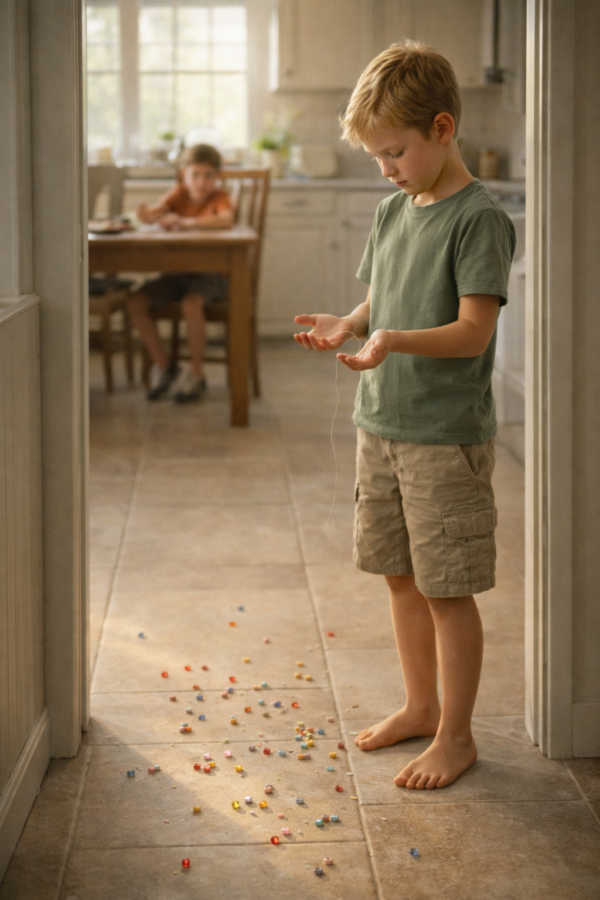

Your child behaves beautifully at school. Teachers love them. Other parents compliment you. Then they get home – and you barely recognise them. Or maybe it is the other way around: charming at home, and you keep getting reports of something very different happening when you are not there. Either way, you have started to wonder: which one is the real them? And what do I do about the gap?
That gap – between who your child is when they are being watched and who they are when they are not – is one of the most common and most quietly unsettling things parents notice in the middle years. You are not imagining it. And it does not mean you are failing. It means your child is in the middle of one of the most important developmental tasks of childhood: learning the difference between performing good behaviour and actually living it.
Here is what the research says about why it happens – and what you can actually do about it.
Why Children Perform Good Behaviour Instead of Living It
Dr. William Damon, Stanford professor and one of the world’s leading researchers on moral development in children, makes a distinction that changes how you see this entirely. There is a difference between a child who behaves well because they fear the consequence of not doing so – and a child who behaves well because they have genuinely absorbed a value as their own. The first child needs an audience. The second child does not.
Most children spend years in the first category – and that is completely normal. Values are not downloaded. They are built, slowly, through hundreds of small experiences and conversations. Dr. Dan Siegel, neuroscientist and author of The Whole-Brain Child, explains that the part of the brain responsible for values-based decision making – the prefrontal cortex – is literally still developing throughout childhood and well into the mid-twenties. Your child is not being two-faced on purpose. They are building something that takes years to complete.
What this looks like in real life: the child who is kind and cooperative at school but explosive at home (home is safe – the mask comes off). The child who plays fair in front of you but cheats at a board game the moment you leave the room (consequence management, not values). The child who is generous with friends but cruel to siblings (audience awareness – siblings do not count yet as a “real” audience). None of these are character flaws. All of them are signals about where the value has not yet been internalised.
Michele Borba, educational psychologist and author of UnSelfie, found that children internalise values fastest in homes where good character is noticed, named, and celebrated – not just where bad behaviour is corrected. Punishment teaches children what not to do in front of you. Recognition teaches them who to be when you are not there. That distinction is everything.
What Is Actually Happening in Their Brain
When your child does the wrong thing when they thought no one was watching, it rarely means they do not know right from wrong. Most children this age know exactly what is right. The gap is between knowing and choosing – and that gap lives in the brain’s threat-response system.
Siegel explains it this way: when a child faces a moment of temptation – the easy shortcut, the chance to take something, the opportunity to get away with something – two parts of their brain are competing. The lower brain fires fast: do what feels good now, avoid discomfort now. The prefrontal cortex – still developing – tries to apply the brakes: but this is not right, this is not who we are. In younger children especially, the lower brain wins a lot. Not because they are bad. Because the brakes are not fully built yet.
What builds those brakes? Repetition. Every time a child is in a values moment – tempted to take the easy wrong instead of the harder right – and chooses well, the neural pathway for that choice gets slightly stronger. Every time that moment is noticed and named by a parent, it gets stronger still. You are not just praising behaviour. You are literally helping build the architecture of their character.
What the Bible Says About This
Scripture has a word for the person who has closed that gap entirely – who is the same in every room, the same whether anyone is watching or not. That word is integrity.
“The integrity of the upright guides them, but the unfaithful are destroyed by their duplicity.” – Proverbs 11:3
The word integrity shares its root with “integer” – a whole number, undivided. A person of integrity is not managing two versions of themselves. They are simply, consistently, wholly one person – and that wholeness means they do not need an audience to behave well, because their behaviour is not a performance. It is just who they are.
“Speaking the truth in love, we will grow to become in every respect the mature body of him who is the head.” – Ephesians 4:15
Notice both parts: truth and love. Honesty without kindness is harshness. Kindness that avoids truth is flattery. The goal for our children is both at the same time – and that starts with watching us do it first.
What This Looks Like at Different Ages
Ages 4 – 6: At this age the gap is widest and most visible – and least worrying. Children this age are entirely audience-dependent. They need you watching to make the right call most of the time. Your job is not to close the gap overnight. It is to begin building the language: “we do the right thing even when no one is watching.” Plant the seed. Do not expect the harvest yet.
Ages 7 – 9: Children this age are beginning to develop a genuine sense of self – who they are, what kind of person they want to be. This is the window where identity language lands hardest. When you say “that is who you are – someone who does the right thing even when it is hard” – they can start to hold that. Catch them being good privately and name it specifically. This is the most important age for this work.
Ages 10 – 13: The peer audience becomes everything at this age. Children this age are intensely aware of what their friends think, which means integrity under social pressure becomes the real test. The conversations shift from “who are you when no one is watching” to “who are you when your friends are watching and expecting something different.” Keep the language going. Ask questions rather than giving lectures. They are forming their own answers now – your job is to be in the conversation.
Four Things to Try at Home
1. Catch them being good when no one was watching – and name it as identity. The next time you discover your child did something right when they thought no one would notice – tidied without being asked, told the truth when the lie would have been easy, stood up for someone when there was no reward in it – stop and name it specifically. Not just “good job” but: “I noticed you did that even when you thought no one was looking. That is who you actually are.” You are not just praising a behaviour. You are handing them a self-concept. Children live up to the identity their parents hand them – make sure the one you are handing them is true and good.
2. Build family language around “who we are when no one is watching.” Make this a phrase your family actually uses – at the dinner table, in the car, in the small ordinary moments. When a decision comes up, ask it together: “What would we do if no one was watching?” Over time this stops being a question and starts being a compass. Your child will carry it into rooms you will never see – and that is exactly the point. You cannot be everywhere. But the right question, asked enough times, can be.
3. Tell them about a time you got it wrong when you thought no one was looking. This one is uncomfortable – which is exactly why it works. When children discover their parents are real, honest, and still growing, it removes the performance pressure that keeps the gap wide. You do not need to confess anything dramatic. Just a genuine moment: “I remember doing something I knew was not right because I figured no one would find out. Here is what it felt like. Here is what I wish I had done.” That story will do more than any rule on the wall – because it shows them that integrity is not a standard you were born meeting. It is something you chose, keep choosing, and sometimes get wrong.
4. When it goes wrong – and it will – stay steady. Your child will make the wrong call when no one is watching. More than once. That is not failure – that is the process. What matters most is what happens after. If the response to a values failure is disproportionate shame or anger, children learn to hide their failures better. If the response is calm, honest, and restorative – “what happened, what were you thinking, what would you do differently” – they learn that failure is not the end of the story. Integrity is built in the recovery as much as in the original choice. Keep going. Keep naming the good. Keep having the conversations. This is a long build, not a single lesson.
What to Do When It Keeps Happening
If you have tried naming the good, building the language, and having the honest conversations – and the gap is still wide – do not give up and do not catastrophise. Character formation is genuinely slow work. Research consistently shows it takes months of repeated experience, not days. A few things worth checking:
Is the behaviour driven by fear? If your child is performing well in high-stakes environments and falling apart in low-stakes ones, it may not be a values gap at all – it may be anxiety. A child who behaves perfectly at school because the social consequences of not doing so feel terrifying is not demonstrating good character. They are managing fear. The treatment there is different: less focus on values language, more focus on safety and connection.
Is home safe enough for the mask to come off? The child who is worse at home than anywhere else is often the child who feels safest at home. That is actually a good sign – but it means the work is not to tighten the rules. It is to build more connection, more repair rituals, more “we are okay even when things go wrong here” experiences.
Are the consequences at home consistent? Children are remarkably good at running experiments. If the gap between “consequence when caught” and “no consequence when not caught” is large, they will rationally exploit it – not out of bad character but out of normal cognitive development. Consistent, calm, predictable consequences close that gap faster than anything else.
The Deeper Thing
The goal is not a child who performs good behaviour for every audience. It is a child who has so thoroughly absorbed good values that the performance drops away entirely – and what is left is just a person you can trust in every room. That kind of character does not come from fear of getting caught. It comes from genuinely knowing who you are and choosing to live from that, even when the choice is invisible to everyone but you and God.
It is built slowly. In the small moments. The chore done without being asked. The kind word said to someone who could not do anything for them in return. The truth told when the lie was right there and easy. Every one of those moments – noticed, named, and celebrated – is a brick. You are not just correcting behaviour. You are building a person. Keep going. The gap closes slower than you want it to – and faster than you think it will.
One Thing to Sit With
Think about the last week in your home. When did you catch your child being genuinely good – not for you, not for a reward, just because it was the right thing? Did you name it? If not, it is not too late. Go tell them. Even now.
Further reading: The Whole-Brain Child by Daniel J. Siegel and Tina Payne Bryson | UnSelfie by Michele Borba | The Moral Child by William Damon
Looking for more faith-filled stories? Browse the full library of Bible heroes for kids at Faith Force. For a verse to anchor this conversation, read Proverbs 12:22 on Bible Gateway.