
It started as an ordinary beach morning – your kids knee-deep in the shallows, half-interested in their sand castles. Then a dolphin surfaced ten feet out, leaped clean into the air, and every child on that beach froze with their mouths open. Nobody told them to stop. Nobody announced a lesson. They just knew, in some deep wordless place, that something joyful and alive had just said hello to them.
That moment – that pure, unguarded delight – is worth sitting with for a while. Because what you just witnessed was not random. It was designed.
What Dolphins Can Teach Us
Dolphins are among the most socially rich creatures on the planet. They live in pods that can range from a handful of individuals to thousands in what researchers call superpods – massive, fluid gatherings where different family groups come together for reasons that still puzzle scientists. They greet each other with specific whistles that function almost like names. Each dolphin develops its own signature whistle within the first few months of life, and pod members learn to recognize and call out to one another using those sounds. They remember. They return. They seek each other out.
But here is the part that stops marine biologists in their tracks: dolphins play even when they have nothing to gain from it. They surf waves created by the bows of ships – not because it helps them hunt or escape predators, but apparently because it is exhilarating. They blow bubble rings underwater and then swim through them. They toss seaweed back and forth in what looks unmistakably like a game. Young dolphins spend enormous amounts of time in play, and adults never stop. Even elderly dolphins have been observed joining in. Play is not a phase they grow out of. It is woven into who they are.
Dolphins also demonstrate profound care for the vulnerable in their pods. When a member is injured or ill, others will support them near the surface so they can breathe. Mothers have been documented staying beside calves who did not survive for days, unwilling to leave. When a pod member is threatened by sharks, others form a defensive ring. They do not abandon their own. The same creatures that leap for sheer delight are also capable of extraordinary loyalty and sacrifice.
God wired joy and community into the same creature – and did so with a purpose. The dolphin is a living picture of what it looks like when delight and devotion exist together. Play is not the opposite of care. In fact, for dolphins, they seem to flow from the same source.

The Biblical Mirror
The book of Nehemiah contains one of the most unexpected lines in all of scripture. The people of Israel had returned from exile. They were listening to the Law being read aloud for the first time in a generation, and many of them were weeping – overwhelmed by how far they had wandered. And into that moment of grief, Nehemiah spoke something stunning: “Do not grieve, for the joy of the Lord is your strength” (Nehemiah 8:10). Joy is not a reward for getting everything right. It is the very fuel that keeps you standing.
David understood this. His psalms swing between raw anguish and explosive praise, sometimes within the same breath. He danced before the ark of the Lord with all his might (2 Samuel 6:14) – a display so exuberant that his wife found it embarrassing. But David was not performing. He was doing something ancient and true: expressing to God exactly what he felt in his body, his whole being responding to the reality of who God is. That kind of joy is not manufactured. It erupts when someone truly knows they are loved and held.
Community – genuine, loyal, let-me-carry-you-to-the-surface community – shows up throughout scripture as one of God’s most consistent designs for his people. “Carry each other’s burdens, and in this way you will fulfill the law of Christ” (Galatians 6:2). The early church in Acts 2 gathered daily. They shared meals, they worshipped, they gave to whoever had need. Joy and community were not separate tracks. They happened together, in the same rooms, around the same tables. Dolphins, it turns out, are living an ancient pattern.
For Your Kids
Ages 5-7
Little ones at this age are already natural dolphins – they play hard, they want to be near their people, and they feel joy in their whole bodies. The best thing you can do is name what they already know. “Did you see how happy that made you? God put that happiness inside you. It is a gift from Him.” Help them connect their laughter and delight to the One who invented it. When they play, remind them that sometimes being silly and joyful is a way of saying thank you to God for making life so good.
Ages 8-10
Kids this age are starting to navigate social complexity – who is in the group, who is left out, whether being joyful is cool or embarrassing. This is a great time to talk about the difference between happiness (which depends on circumstances) and joy (which is anchored in something deeper). Ask them: “Have you ever felt really joyful even when things were not perfect?” Point them to Nehemiah 8:10 and talk about what it means that joy is strength – not just a feeling, but something that holds you up when everything else feels shaky.
Ages 11-13
Preteens often absorb the message that maturity means becoming more serious and less joyful – that play is childish and delight is naive. Counter that directly. Talk about David dancing before the ark and why some people thought it was undignified – and what David said in response. He did not care what it looked like. He was responding to God. Ask your preteen: “What would it look like to let joy be a form of worship in your life this week?” This opens a real conversation about authenticity, about what they actually feel when they praise God, and whether their faith has room for genuine delight.

This Week’s Challenge
One Action
Do something purely joyful as a family this week – something with no productive purpose, no lessons attached, no screens. Jump in a pile of leaves. Have a water fight. Play a ridiculous board game until everyone is laughing. Before you start, say out loud: “We are doing this as an act of worship. God made us for joy.” Then actually play. Let it be real.
One Conversation Starter
Dolphins play even when they are old and have nothing to prove. What do you think God was saying about life when He made them that way? What is one thing that brings you pure joy – not because it is useful, just because it is wonderful?
One Verse
“The joy of the Lord is your strength.” – Nehemiah 8:10
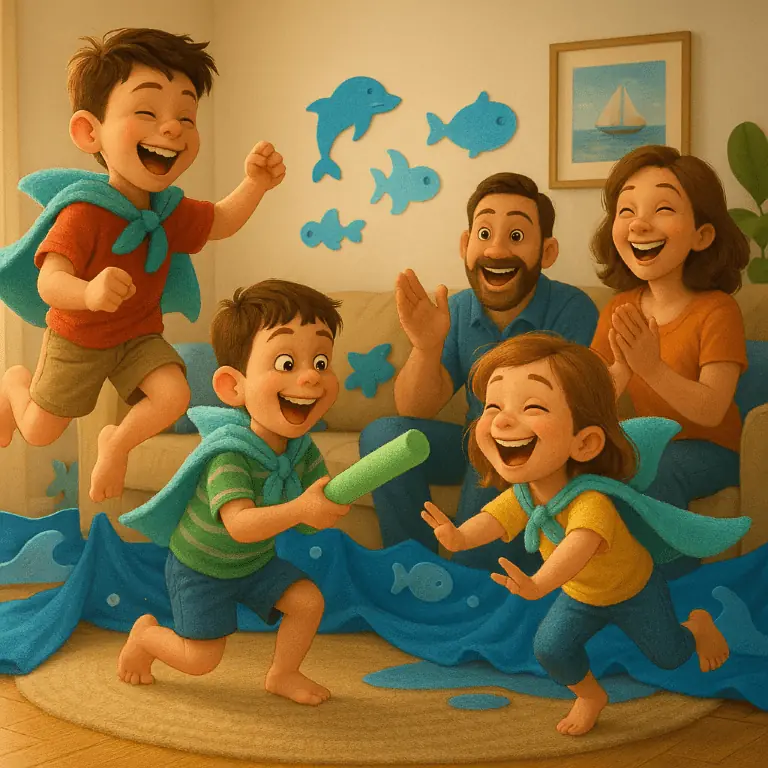
Family Activity
Gather your family with paper and markers. Each person draws their own Joy Pod – a circle in the middle with their name, then surrounding bubbles for the people, places, and things that bring them genuine joy. Include things from nature, moments with family, quiet things, silly things – whatever is real. When everyone is done, share your pod with each other.
Then talk through these questions together, letting the conversation breathe:
Discussion Starters
- Dolphins have specific whistles for each other – like names they use to call out to their friends. Who are the people in your life you would swim across the ocean to find?
- Is there a difference between being happy and being joyful? Can you think of a time you had joy even when things were hard?
- David danced before God with everything he had, even when people thought it was embarrassing. When have you expressed joy to God in a big way? What held you back if you have not?
- Dolphins take care of injured pod members – they hold them up so they can breathe. Who in your life needs someone to hold them up right now? How could we do that together?
- If joy is a form of worship, what is one joyful thing you want to do this week that you will dedicate to God?

A Prayer to Close
Lord, You made dolphins to leap and play and call each other by name, and somewhere in that You were telling us something about who You are. You are not just the God of the serious and the striving. You are the God who invented joy. Teach our family to play as an act of worship. Teach us to hold each other up when the waves get rough. And when we laugh today – really laugh, the kind that comes from somewhere deep – may we remember that it is a gift from You. Amen.
One Last Thing
There is a reason your children stopped everything when that dolphin leaped. Something in them recognized something true – that life is not only meant to be endured or managed. It is meant to be savored, shared, and occasionally leaped through with everything you have. That recognition came from somewhere. It came from the same place joy always comes from: a God who could have made the ocean gray and silent, but did not.
Dolphins did not invent joy. They are reflecting it back to us – a tiny, exuberant echo of the One who thought joy was worth building into the very fabric of creation. Your family can carry that same reflection. Not because you have it all together, but because you know the Source. That is more than enough to leap about. Want to learn more about these amazing creatures? Explore dolphins at National Geographic Kids.
Want more stories like this? Explore our Character Tales for more animal stories that teach real virtues, or grab a free printable activity to take the lesson further.