
Everyone was afraid of Goliath.
Everyone except one boy.
For forty days, the giant came.
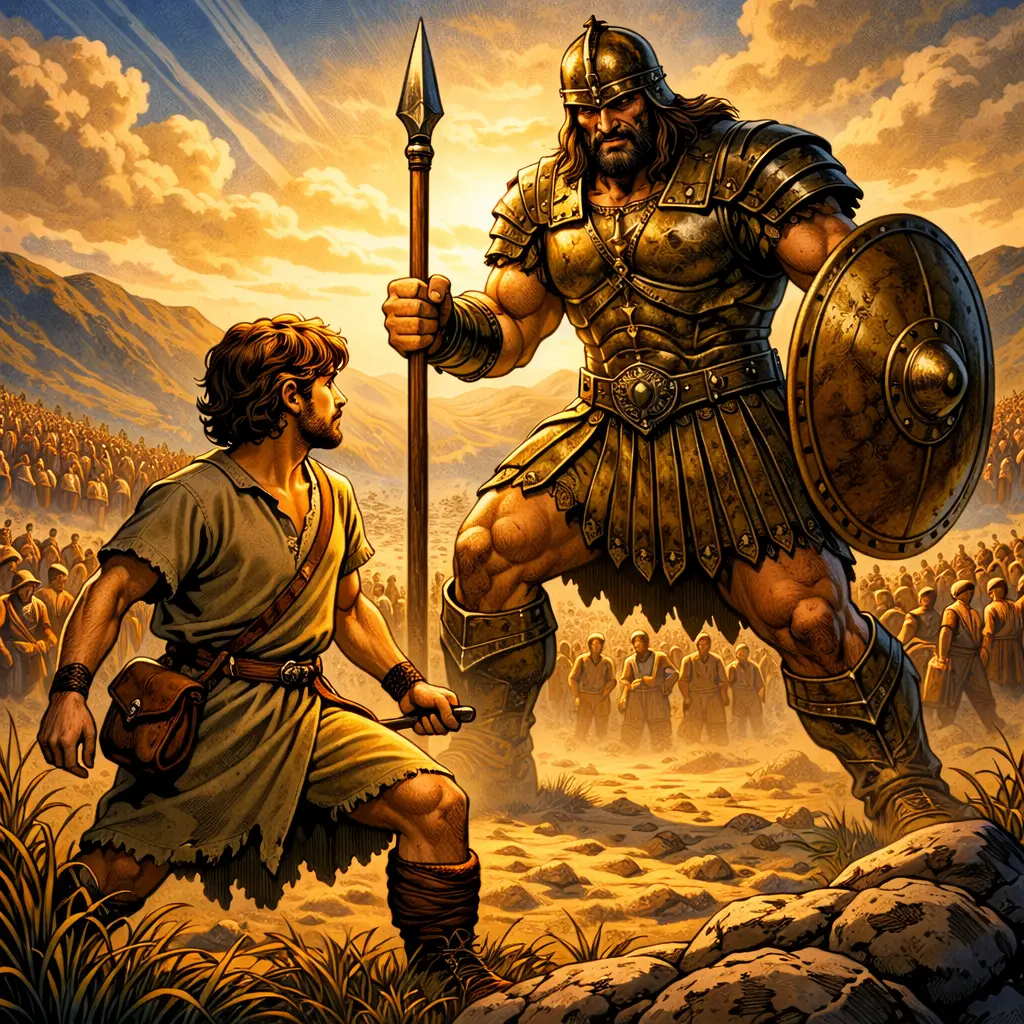
Every morning, he walked out of the Philistine camp and stood at the edge of the Valley of Elah. His bronze armour caught the sun. His spear was so thick and heavy it looked like a weaver’s beam. He was over nine feet tall - taller than any man in Israel had ever seen.
And every morning, he shouted.
His voice rolled down the valley like thunder, shaking the ground, filling the Israelite camp from one end to the other.
“Send me a man! One man! Let him fight me - and whoever wins, the other side becomes their servants.”
Forty days. The same challenge. The same thundering voice. The same silence from the Israelite side.
Because no one moved.
Not the soldiers in their armour. Not the officers with their swords. Not even King Saul - who stood a head taller than every other man in Israel. The Bible says when they saw Goliath, they were terrified and ran.
Every. Single. Day.
Then a shepherd boy arrived.
His name was David. He was the youngest of eight brothers, and his job that week was to bring food to his older brothers at the camp. He was not a soldier. He did not have armour. He was not supposed to be there at all.
He heard Goliath’s voice for the first time as he was talking to his brothers.
And he asked a question that stopped everyone cold.
“Who is this man, that he should speak like that? Why is nobody going out to meet him?”
His oldest brother, Eliab, turned on him immediately. His face went red with anger.
“Why are you even here? You are supposed to be watching the sheep. You just came to see the excitement.”
David was dismissed. By his own brother. In front of everyone. He was called too young, too small, too unimportant to be there. He was told to go back to the sheep where he belonged.
But something in David did not move.
He went to King Saul.
“Let no one be discouraged because of this Philistine,” David said. “I will go and fight him.”
Saul looked at the boy in front of him and said what everyone must have been thinking: “You are too young. He has been a soldier since he was a boy.”
And this is where David said something remarkable.
He told Saul about the lion. And the bear.
When a lion had come to take a lamb from his flock - David went after it. He struck it down and rescued the lamb from its mouth. When it turned on him, he grabbed it by the fur and killed it. He had done the same with a bear.
“The same God who saved me from the lion and the bear,” David said quietly, “will save me from this Philistine.”
He was not boasting. He was remembering.
He was saying: I have been here before. In a smaller field, with a smaller giant, I learned something true. I am not alone. I have never been alone.
Saul agreed. He even tried to help - he gave David his own royal armour. A bronze helmet. A coat of mail.
But David put it on and could not walk. It was not his. It had never been his. He took it off and set it down.
He walked to the stream at the bottom of the valley - the cold water running over smooth rocks - and he chose five stones. Small. Round. Ordinary.
He put them in his shepherd’s bag, sling in hand, and walked toward Goliath.
The giant saw him coming and did not hide his contempt.
“Am I a dog, that you come at me with sticks?” He cursed David loudly. His voice filled the valley the way it always had. “Come here. I will give your body to the birds.”
But David did not stop walking.
And here is the moment. Not what happened next - but what happened inside David, right there, in the middle of the valley, with forty days of fear pressing in from one side and nine feet of bronze armour pressing in from the other.
David chose.
Not because he was not afraid. We do not know what he felt in his body in that moment - the dry mouth, the sound of his own heartbeat, the weight of the stone in his hand. We only know what he chose.
He chose to remember what was true.
“You come at me with a sword and a spear,” David called back. “But I come in the name of the Lord of hosts - the God of the armies of Israel, whom you have defied.”
He reached into his bag.
He placed the stone in the sling.
And he ran toward the giant.
One stone. One throw.
It struck Goliath in the forehead and he fell face down in the valley - the great, roaring, terrifying giant - face down in the dust.
The army that had not moved for forty days began to shout. And then to run - forward this time. After forty days of running away, they ran toward.
Because one boy had gone first.
—
Here is what the story is really about.
It is not about the sling. It is not about the stone. It is not even about the giant.
It is about a moment in the middle of a valley when everything in the world said you are not enough - and a boy decided that was not the final word.
David had no armour. He had no training. He had no rank. He had a sling he had used for sheep, a God he trusted from experience, and a decision.
That decision is what courage is.
Not the absence of fear. Not the guarantee of winning. Just the choice - made in one ordinary moment, by one ordinary person - to move forward anyway.
Your child has that same choice available to them.
Not in a valley. Probably in a classroom, a playground, a hallway, a moment at home when it is easier to stay quiet than to do the right thing.
The giant changes. The moment does not.
And every time they pick up their stone and take a step - they are doing exactly what David did.
THE END
Based on 1 Samuel 17. All dialogue is retold from the biblical narrative and is not a word-for-word quotation.
