Mission Briefing
David was not supposed to be there.
He was the youngest of eight brothers – the one left behind to watch the sheep while his older brothers went to war. He was not a soldier. He had no armour, no rank, no military training. His job was to keep the flock safe and bring his brothers lunch when they needed it.
But David had something his brothers did not have that day.
He had already faced a lion alone in a field. He had already faced a bear. He had already stood in the dark, heart hammering, and chosen to move forward anyway – not because he was fearless, but because something in him knew he was not alone.
By the time he arrived at the Valley of Elah and heard a giant’s voice rolling across the hillside like thunder, David was already the most experienced person in that camp at doing the very thing everyone else was terrified to do.
He just did not know it yet.
Mission Verse
“You come against me with sword and spear and javelin, but I come against you in the name of the Lord of hosts – the God of the armies of Israel, whom you have defied.”
One way to read David’s words to Goliath (from 1 Samuel 17:45) is this: courage is not about what you are carrying. It is about who you know is with you.
Mission Briefing
For forty days, a giant named Goliath had walked out of the Philistine camp every morning and shouted the same challenge across the Valley of Elah. He was over nine feet tall. His bronze armour caught the sun. His spear was so thick and heavy it looked like a weaver’s beam. And every morning, the entire Israelite army – trained soldiers, experienced officers, even King Saul himself – heard that voice and ran.
Forty days. The same challenge. The same silence. The same fear.
Then a shepherd boy arrived with a bag of lunch and a question nobody else had thought to ask: “Why is nobody going out to meet him?”
His oldest brother told him to go back to the sheep. King Saul told him he was too young. The giant laughed when he saw him coming. Every voice in that valley – human and giant alike – said the same thing: you are not enough for this.
And here is what courage actually looked like that day.
It did not look like fearlessness. It did not look like certainty. It looked like a boy who walked to a cold stream, chose five ordinary stones, placed one in his sling, and ran toward the thing that had stopped an entire army in its tracks – because he had decided that the voice of fear was not going to be the last word.
David won. But the real victory happened before the stone ever left the sling. It happened the moment he decided to move.
Courage is not the absence of fear. It is deciding that something matters more than the fear.
Your Child and This Moment
Your child will not face a nine-foot giant this week.
But they will face a moment – probably more than one – where the brave thing is also the harder thing. Where every voice says stay quiet, stay safe, stay small. Where doing the right thing costs something.
David’s story is not about a sling. It is about that moment of decision – the one that happens inside a person before anything visible happens on the outside.
When your child faces their giant this week – the unkind comment they could ignore or address, the friend who needs someone to sit with them, the apology that feels too hard to give – they have a choice. They can run like the army. Or they can pick up their stone.
Put It Into Practice
- Name your giant. Ask your child: what is one thing that feels scary or hard right now? Write it down or draw it. Naming it is the first step toward facing it.
- Find your stone. David used what he already had. What strength or quality does your child already have that could help them face it? Remind them – they already have what they need.
- Take one step. Do one brave thing this week, even a small one. Speak up kindly. Sit with someone who is alone. Try the thing you have been avoiding. Tell someone in your family when you do it.
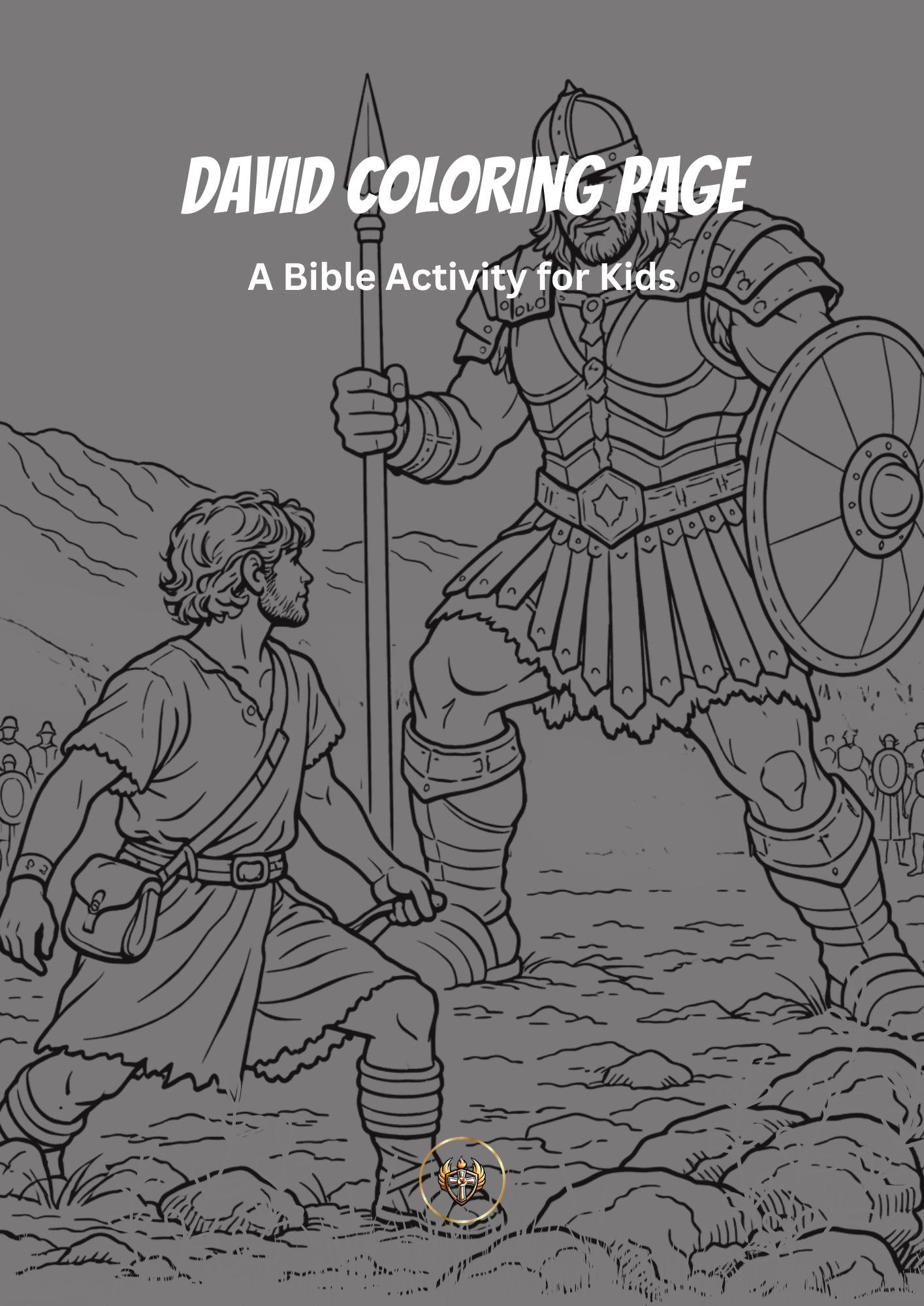
Get the free printable coloring page →
Hero Mission Activity – Pick Your Stone
David did not need special armour. He did not need special training. He walked to the stream, chose five smooth stones – small, ordinary, exactly what he already had – and that was enough.
What you need: paper, pencils or crayons, and five minutes together.
What you do: Ask your child to draw or write five things they already have – strengths, qualities, or people in their corner. These are their stones. Then ask them to circle the one they want to carry into this week.
Talk about it together:
- Ages 4-6: Was David scared of the giant? What do you think he did when he felt scared?
- Ages 7-9: David’s brother told him he was too small and too young to help. Have you ever felt like that? What did you do?
- Ages 10-13: David had already faced a lion and a bear alone – and that gave him confidence to face Goliath. What is a hard thing you have already done that proves you are braver than you think?
This week’s challenge: Find one moment where the brave thing is also the harder thing – and choose it anyway. When you do it, tell someone in your family. That is your stone. That is your giant.
Mission Prayer
If your family prays together, here is a simple prayer for this week:
“God, give us courage like David’s – not the kind that has no fear, but the kind that moves forward anyway. Help us remember what is true when everything around us says we are not enough. Amen.”
♥ Mission Prayer
God, thank You for being bigger than our fears. Help us trust You when we feel scared and give us courage to do what is right. Amen.