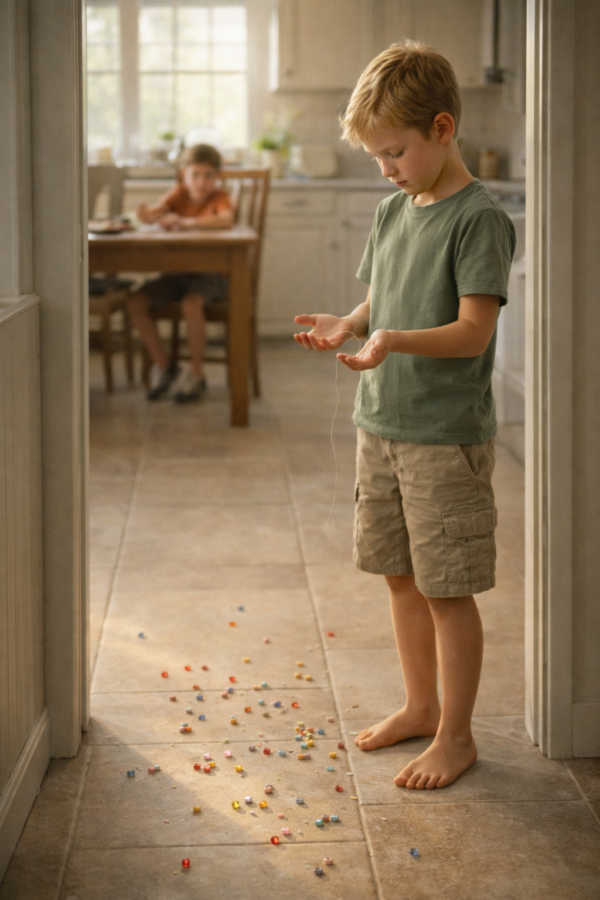
Your child rolls their eyes when you ask them to do something. Or they talk back in a tone that would have been unthinkable when you were their age. Or they are perfectly polite to adults in public – teachers love them, other parents think they are delightful – and then come home and speak to you or their siblings in a way that makes it clear the politeness is a performance for the right audience. Or they dismiss a classmate with a carelessness that makes you wince, not because they are cruel, just because it never crossed their mind that person’s feelings mattered.
Most parents respond to disrespect the same way: they address the behaviour. Stop the eye roll. Correct the tone. Make the apology happen. And the behaviour changes – temporarily, in that moment, in front of you. Then it comes back. Because the behaviour is not actually the problem. The problem is that the child has not yet understood something true: that every person they encounter – the parent, the sibling, the overlooked classmate, the school caretaker – carries a worth that is not contingent on how impressive or useful or likeable they are. That understanding is not caught from a rule. It is built from a belief.
Here is what the research says about how genuine respect develops in children – and what builds the belief that produces it.
Why Respect Is More Than Manners
Dr. Michele Borba, whose research on character development in children spans three decades, draws a sharp distinction between social compliance and genuine respect. Social compliance is what most parents are actually teaching when they address disrespectful behaviour: stop the eye roll, use the right tone, say please and thank you. Children can master social compliance completely while having no internal sense of the worth of the people around them. They are managing an audience – performing respect for the people who can reward or punish them, and dropping it the moment the audience changes.
Genuine respect is something different. It is the internal recognition that another person has inherent worth – not earned worth, not conditional worth, but worth that is simply there because of who they are. Dr. Thomas Lickona, author of Raising Good Children and one of the most influential researchers on moral development in children, argues that this recognition is the foundation of all other respectful behaviour. You cannot reliably produce respectful actions in a child who does not hold a respectful view of people. But a child who genuinely believes that people matter will produce respectful behaviour naturally – even when no one is watching, even toward people who cannot benefit them, even toward people they find difficult.
The question then is not how to manage the disrespectful behaviour. It is how to build the belief that makes respect genuinely internal. And that belief, research consistently shows, is caught far more than it is taught – from the adults in the home who model it in the ordinary moments of daily life.
What Is Actually Happening When a Child Is Disrespectful
When your child rolls their eyes or uses the dismissive tone, two things are usually true simultaneously. First: they have not yet internalised the belief that the person in front of them has inherent worth that demands a different response. Second: they have learned, from watching the world around them, that some people are worth more careful treatment than others – that respect is a social calculation based on power, popularity, or usefulness rather than personhood.
Dr. Ross Greene’s research on behaviour adds something useful here: many children who are chronically disrespectful are actually lacking a specific skill – the ability to manage frustration or disappointment without expressing it through dismissiveness or contempt. They are not choosing to be disrespectful so much as defaulting to it when the emotional regulation required to respond differently is not yet fully built. That does not make the behaviour acceptable. It does mean that correction alone – without skill-building and belief-building – will keep producing the same cycle.
What the Bible Says About This
Scripture grounds respect not in social convention or positional authority but in something that cannot be argued away by circumstances or feelings: the image of God in every person.
“So God created mankind in his own image, in the image of God he created them; male and female he created them.” – Genesis 1:27
This is the foundation. Every person your child will ever encounter – the teacher, the sibling, the overlooked classmate, the difficult neighbour, the person whose life looks nothing like theirs – was made in the image of God and carries His imprint. That worth does not fluctuate with how likeable or impressive or useful they are. It is simply there. Teaching children that respect flows from this truth is not teaching manners. It is teaching theology – the right way of seeing people, the way God sees them.
“Show proper respect to everyone, love the family of believers, fear God, honour the king.” – 1 Peter 2:17
Everyone. Not just people in authority. Not just people you like or agree with. Not just people who are watching. The standard Scripture sets is unconditional – every person, in every context, deserves to be treated with the dignity that their being image-bearer demands. That is a higher and more radical standard than anything social etiquette produces. And it is the standard a child who understands the image of God will naturally try to live up to.
What This Looks Like at Different Ages
Ages 4 – 6: At this age connect the behaviour to the belief from day one: “We listen when someone is talking because their words matter – and they matter because God made them.” Not just “we listen” but why we listen. Not just “say sorry” but “that person was made by God and feels things just like you do – what do you think they felt when you did that?” You are building the vocabulary of inherent worth long before they can articulate it. When you see your child treat someone well – especially someone they did not need to bother with – name it: “You noticed that person and treated them with kindness. That is what respect looks like.”
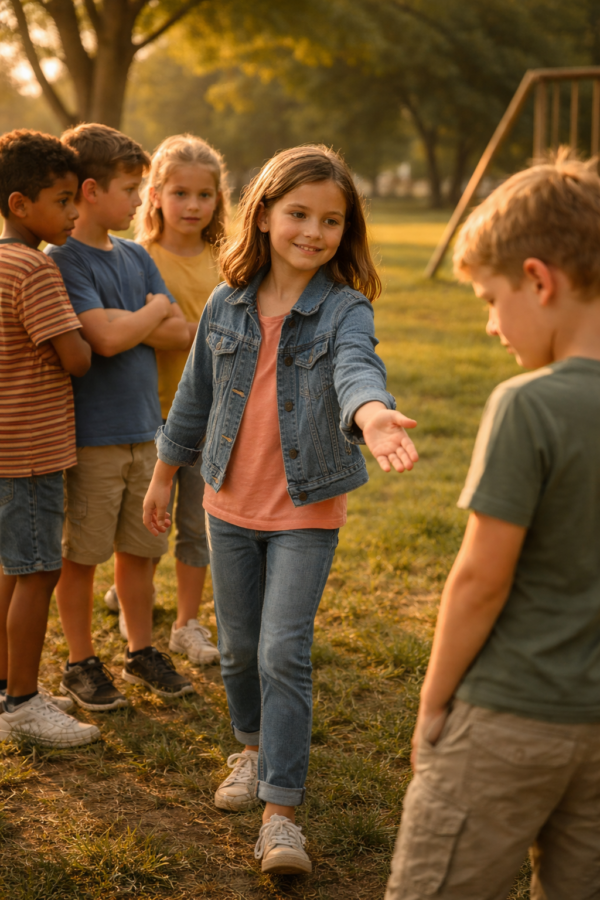
Ages 7 – 9: This is the age to introduce the concept explicitly: some people are treated as though they matter less. Ask at dinner: “Who in your school is treated with the least respect by other kids? Why do you think that is? What would it look like to treat them differently?” Then read the Sam and Mr. Chen story together – or better, ask your own version: “Is there someone at school who everyone walks past without really seeing?” Children this age are beginning to notice social hierarchies and to feel the pull of them. Naming what they see – and asking what God says about the worth of every person on every rung – plants something that does not leave easily.
Ages 10 – 13: Digital life becomes the major arena for disrespect at this age – the comment left, the screenshot shared, the group chat that talks about someone who is not there. Read 1 Peter 2:17 and ask directly: “Does ‘show proper respect to everyone’ include how you speak about people online? Does it include the group chat?” This is not a lecture – it is an honest question that most children already know the answer to. Also tackle the harder conversation: “Is there a person or a group you find it genuinely difficult to respect – someone your friends dismiss or your culture says is less than? What does God say about their worth?”
Four Things to Try at Home
1. Anchor the rule to the reason – every time. When you correct disrespectful behaviour, do not stop at the behaviour. Add the reason: “That tone was disrespectful – and that person was made by God and deserves better from you.” Do this consistently enough and the reason begins to do the work on its own. Children who understand why respect is owed – not because of social rules but because of the inherent worth of every person – have an internal reference point that functions even when you are not there to enforce the external one.
2. Ask who gets overlooked. Make this a regular dinner table question: “Who in your world this week was treated as though they mattered less? Who did people walk past?” Then follow up: “What would it look like to treat that person differently?” Lickona’s research is clear that children who are regularly invited to notice the overlooked people around them develop a sensitivity to the worth of others that becomes habitual. You are not just building empathy. You are building the habit of seeing – which is the foundation of all genuine respect.
3. Watch what you model in private. The most powerful respect curriculum in your home is how you speak about people when they are not there. The neighbour who is difficult. The family member with the long history. The person in the news. The colleague who let you down. If children hear the adults in their home speak dismissively, mockingly, or contemptuously about people in private, they learn that respect is a performance for the people who are present – and can be dropped the moment they are not. Nothing you say about respect will outweigh what they observe. How do you speak about people when they cannot hear you?
4. Celebrate respectful behaviour toward people who cannot benefit your child. The real test of respect is what your child does toward someone who has no social power – the unpopular classmate, the overlooked adult, the person on the edges of every group. When you catch your child being respectful toward someone like that – stopping to talk, including them, treating them with dignity when no one was watching – name it as identity: “You did not have to do that. Nobody would have noticed if you had not. But you saw that person and treated them with respect. That is who you are.” That moment – noticed and named – shapes identity more than any conversation about rules.
What to Do When the Disrespect Keeps Coming
If you have anchored the rule to the reason, asked who gets overlooked, modelled respect in private – and the eye rolls and dismissive tone keep coming – do not give up. A few things worth checking:
Is the disrespect at home a sign of safety? Children who are most disrespectful at home and most compliant in public are often children who feel safest at home – the mask comes off where they feel secure. That is not nothing. The work in that case is not tighter rules. It is building more connection, more repair, more “we are still okay even when you get it wrong here.” Disrespect toward parents in the middle years often peaks and then self-corrects as the relationship deepens and the child matures – provided the relationship is strong enough to carry the tension.
Is there a skill gap underneath? Greene’s framework is relevant here: a child who is chronically disrespectful when frustrated or disappointed may need help building the frustration tolerance and emotional regulation that make a respectful response possible in those moments. Before the next correction, ask: “What is happening for you in the moment before you respond that way? What do you need in that moment?” You might find a skill gap rather than a character gap – and skill gaps respond to very different interventions.
Is the peer environment modelling contempt? Children absorb the social norms of their peer group with remarkable speed. A child who has moved into a peer environment where dismissiveness, mockery, and contempt are the social currency will begin to speak the language – not because it is who they are but because social survival feels like it requires it. Name what you are observing without accusation: “I have noticed how you speak about some of the people at school. Is that how your friends talk? What do you actually think about those people?” Open the conversation. Do not assume the peer norm has become the belief.
The Deeper Thing
The goal is not a child who performs respect for the right audience. It is a child who has understood something true and irreversible: that every person they will ever encounter was made by God and carries His image – and that this fact demands a response that no amount of social calculation can undo. That kind of respect does not come from rules. It comes from a belief about people that has been planted, watered, and grown in the ordinary moments of a family that talks about it, models it, and notices it in each other.
It shows up in the tone used with a sibling at 7am when no one is watching. In the way an overlooked person is spoken about at the dinner table. In the child who stops in the school corridor to talk to the caretaker nobody notices. In the comment not left, the screenshot not shared, the thing not said in the group chat. Every one of those moments – small, unspectacular, often unseen – is a brick. You are not just correcting behaviour. You are building a person who sees people the way God sees them. That is one of the most important things you will ever do.
One Thing to Sit With
Think about someone in your own life you find it hard to respect – genuinely hard, not just socially inconvenient. Someone whose choices you disagree with, whose manner irritates you, whose worth you may have quietly downgraded in how you think and speak about them. What does Genesis 1:27 say about that person? Your child is watching not just whether you correct their disrespect but whether you extend respect yourself to the people in your life who are easy to dismiss. That is the lesson that lasts.
Further reading: Raising Good Children by Thomas Lickona | UnSelfie by Michele Borba | The Explosive Child by Ross W. Greene
Looking for more faith-filled stories? Browse the full library of Bible heroes for kids at Faith Force. For a verse to anchor this conversation, read 1 Peter 2:17 on Bible Gateway.