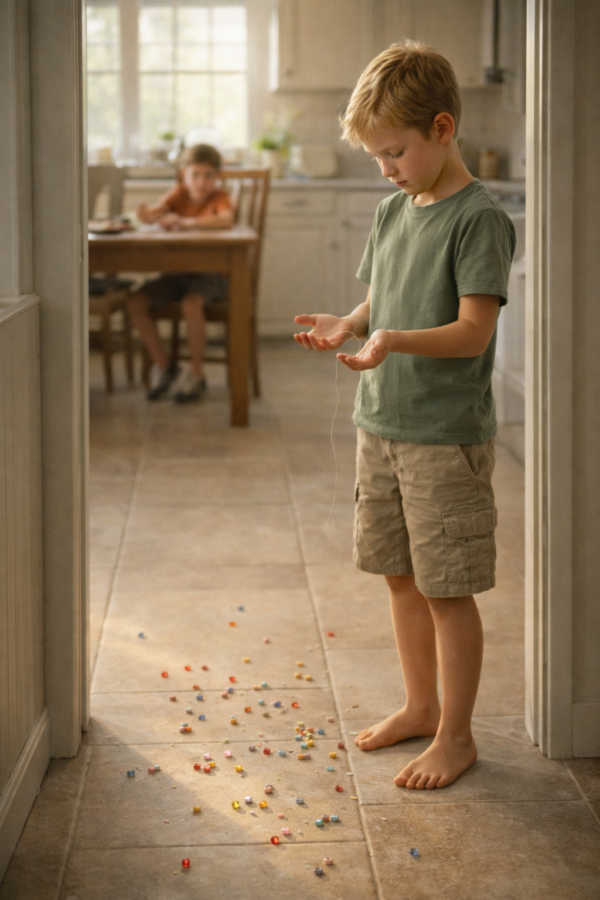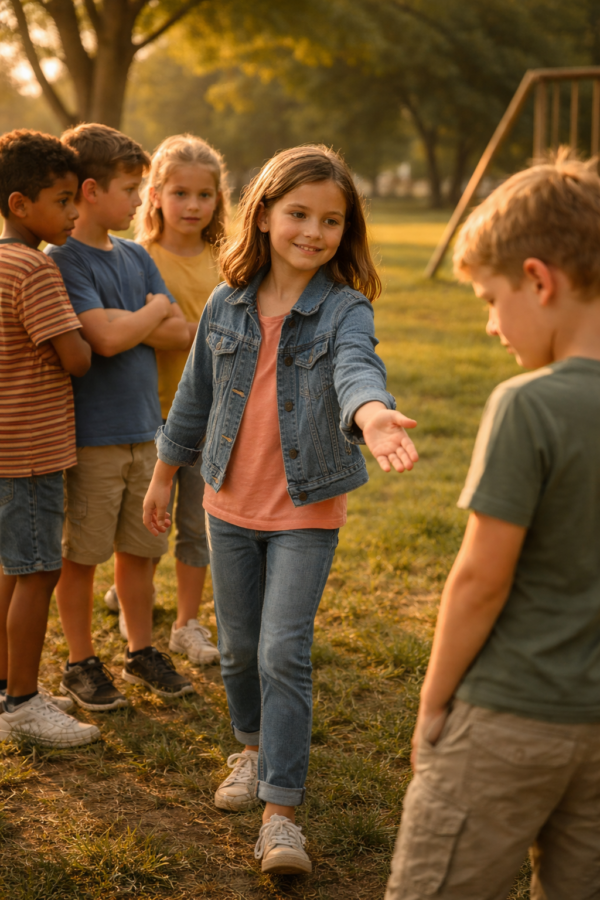
Your child gets a gift – a good one, something they wanted – and within twenty minutes they are asking about the next thing. Or you are driving them somewhere, doing the fourth thing for them today, and they are in the back seat complaining about something minor without any apparent awareness of the five other things that just happened for them without a word of thanks. Or they compare what they have to what a friend has and come home feeling short-changed by something they were perfectly happy with yesterday. And you find yourself thinking: how do I raise a child who is actually grateful? Not just polite. Actually grateful.
Most parents have tried the thank-you-before-you-put-it-down rule. The count-your-blessings conversation. The “do you know how lucky you are?” speech that lands about as well as you would expect. None of it quite reaches the thing you are actually after – which is not better manners but a genuine orientation toward life. A child who wakes up inclined to notice what is good rather than what is missing. That is not a personality type. It is a practised habit. And the research on how to build it is remarkably clear.
Here is what the science says about gratitude in children – and what actually shifts the orientation rather than just managing the behaviour.
Why Children Default to Wanting More
Dr. Robert Emmons, the world’s leading scientific researcher on gratitude and author of Thanks! How the New Science of Gratitude Can Make You Happier, has spent decades studying what gratitude actually does to the brain – and what gets in the way of it. His finding: gratitude is not a natural default. The human brain is wired for what researchers call the “negativity bias” – a survival mechanism that scans for what is missing, what is wrong, what could go better. It is the same mechanism that kept our ancestors alive. It is also the mechanism that makes a child who just received ten good things fixate on the one that was not quite right.
Add to that what Dr. Jean Twenge, author of iGen, calls the “entitlement culture” – a generational shift in which children have been raised to expect comfort, ease, and the satisfaction of their preferences as a baseline rather than a gift. Not because parents are failing, but because the environment delivers so much so easily that the experience of receiving as a genuine act of giving from another person has become rarer. A child who has always had a warm house, filled fridge, and charged device has no felt experience of those things as gifts. They are simply the way things are.
The solution is not deprivation. It is attention – specifically, trained, repeated attention to what has been given and who gave it. Emmons’s research is consistent: gratitude is a practised skill. The brain can be retrained to notice goodness. But it requires deliberate, repeated practice – not occasional instruction. The family that asks “what are you grateful for today?” every single day is literally rewiring the attentional default of their children over time.
What Gratitude Actually Does to a Child
Emmons’s studies on gratitude are among the most replicated in positive psychology. Children and adults who regularly practise gratitude – specifically, writing down what they are thankful for – report significantly higher levels of happiness and life satisfaction, sleep better, feel less anxious, experience fewer physical complaints, and are more likely to help others than those who do not. These are not small effects. In one study, weekly gratitude journaling produced a 25% increase in reported wellbeing.
Dr. Jeffrey Froh, who has conducted the most extensive research specifically on gratitude in children, found that grateful children have more positive emotions, are more satisfied with school and family, are more prosocial, and are less likely to be envious or depressed. Crucially, Froh found that gratitude and anxiety run in opposite directions in the brain – it is very difficult to be simultaneously grateful and anxious, because both compete for the same attentional resources. A child who is regularly oriented toward what they have is significantly less vulnerable to the anxiety spiral that comes from fixating on what they lack or what could go wrong.
Scripture knew this long before the research confirmed it. Philippians 4:6-7 links prayer with thanksgiving directly to the peace that “guards your heart and mind.” Gratitude is not just a pleasant habit. It is a neurological and spiritual defence against anxiety – and it works.
What the Bible Says About This
Scripture does not treat gratitude as an occasional response to exceptional blessing. It treats it as the ongoing, daily posture of a person who has understood something true about where everything comes from.
“Give thanks in all circumstances; for this is God’s will for you in Christ Jesus.” – 1 Thessalonians 5:18
In all circumstances – not just the good ones. This is one of the most important distinctions in the entire biblical teaching on gratitude. It is not telling you to pretend that hard things are fine. It is telling you that even inside hard circumstances, there is something worth noticing and naming. A child who has only ever practised gratitude when things are going well has a fair-weather habit that will fail them in the hard seasons. A child who has learned to find something real to be grateful for even when things are difficult has an anchor that holds.
“Do not be anxious about anything, but in every situation, by prayer and petition, with thanksgiving, present your requests to God. And the peace of God, which transcends all understanding, will guard your hearts and your minds.” – Philippians 4:6-7
Thanksgiving alongside petition – not instead of honest asking, but paired with it. The child who learns to bring their worries to God while also naming what they are grateful for is learning one of the most practically powerful spiritual habits available. Not because it makes the worry go away, but because it changes the emotional context in which the worry is held. Gratitude and anxiety genuinely cannot fully coexist. One crowds out the other.
What This Looks Like at Different Ages
Ages 4 – 6: At this age gratitude is built entirely through habit and naming. Ask the question every single day – at dinner, at bedtime, in the car: “What was one good thing today?” Require specificity: not “everything” but one real, named thing. The specificity is what matters – it forces actual attention rather than reflexive response. When your child receives something good, help them name it as a gift from a person: “Grandma chose that for you. What do you want to say to her?” You are building the vocabulary and the habit. The orientation follows the practice, not the other way around.
Ages 7 – 9: This is the window for the gratitude journal – Froh’s research found it most effective at this age when introduced as a genuine experiment rather than a chore. Give your child a small notebook and ask them to write three specific things they are grateful for each night for thirty days. Not “my family” – “Dad stayed up late helping me with my project even though he was tired.” At the end of thirty days, ask: “Did you notice anything changing during the day? Did you start seeing things you wanted to write down later?” Most children say yes. That shift – noticing during the day – is the attentional rewiring happening in real time.
Ages 10 – 13: At this age the entitlement conversation becomes possible and important. Ask directly: “Is there something in your life right now that you have been treating as an entitlement rather than a gift? What would change if you started receiving it as a gift instead?” Also connect gratitude to anxiety here – read Philippians 4:6-7 together and try it as a practical exercise: bring one real worry to God paired with one specific thing you are genuinely grateful for. Ask: “What did that feel like?” The link between gratitude and peace is not theoretical at this age – it can be experienced.
Four Things to Try at Home
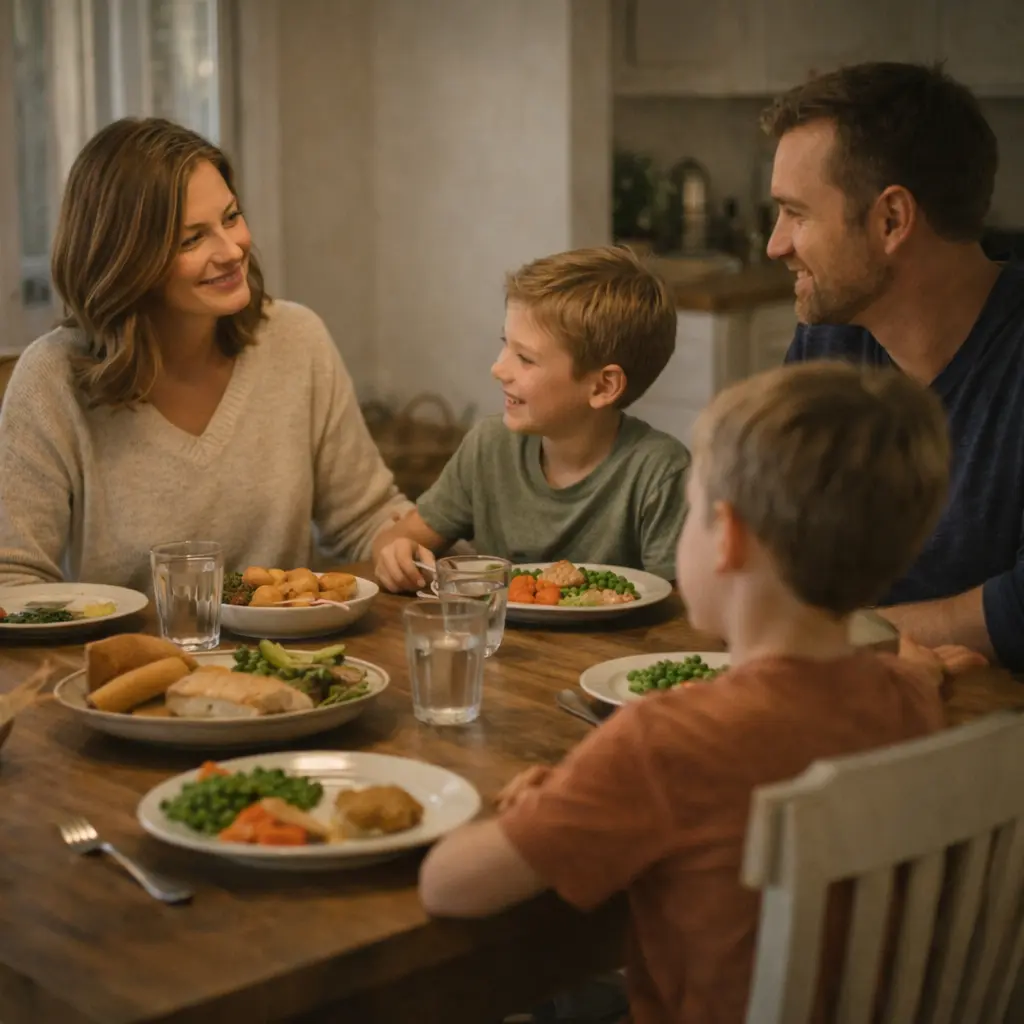
1. Ask the question every single day – and require specificity. The dinner table or bedtime “what are you grateful for?” question is the single most evidence-backed habit for building gratitude in children. But the specificity matters enormously. “I am grateful for my family” is not gratitude – it is a reflex. “I am grateful that Mum came to my game even though it was raining and she had other things to do” is gratitude. It requires actual noticing. It builds the attentional muscle. Make it a non-negotiable daily practice and watch the orientation shift over months, not days.
2. Connect good things to the people who gave them. One of the most effective ways to build genuine gratitude is to make the giver visible. When something good arrives – a meal, a lift, a gift, a favour – name the person and the choice: “Someone made that for you. Someone drove out of their way for you. Someone spent money they earned on you.” Children who experience good things as impersonal and automatic do not feel grateful for them. Children who see clearly that a person chose to do something for them feel the pull of genuine thanks. Make the giver real, and the gratitude follows.
3. Practise grateful-in-the-hard-season, not just grateful-when-things-are-good. The next time something is genuinely difficult in your family – a disappointment, a hard week, a plan that fell apart – resist the urge to either minimise it or spiral in it. Try instead: “This is hard and I am not pretending it is not. And also: what is still good? What is still true? What can we name?” You are not performing positivity. You are modelling the skill of 1 Thessalonians 5:18 – finding what is real and good even inside hard circumstances. That skill, demonstrated by a parent in a genuine hard moment, teaches more than thirty dinner table questions.
4. Teach expressed gratitude, not just felt gratitude. Emmons’s research shows that expressing gratitude to specific people amplifies the effect significantly – both for the person expressing it and the person receiving it. Make this a family practice: write the thank-you note not as a social obligation but as a genuine act of noticing. Say it out loud to the teacher, the coach, the grandparent who shows up quietly. “Thank you for this specific thing you did – it mattered.” Gratitude that stays inside the head is incomplete. Gratitude expressed out loud strengthens the relationship and deepens the habit.
What to Do When the Entitlement Keeps Showing Up
If you have built the daily question, introduced the journal, connected good things to people – and your child still seems to default to wanting more and noticing less – do not give up. Emmons’s research is clear that the rewiring takes months of consistent practice, not days. A few things worth checking:
Is the family conversation oriented toward enough or not enough? Children absorb the emotional atmosphere of a home far more than they absorb explicit instruction. A family where the dominant conversation is about what is lacking, what is unfair, what others have – produces children who are oriented toward scarcity regardless of actual circumstances. A family where the dominant conversation notices and names what is good – produces children who can find something to be grateful for even in a hard week. What does your family talk about at the dinner table? That is the orientation you are building.
Are good things arriving too easily and too fast? A child who has never had to wait for something, save for something, or go without something has no felt experience of receiving it as a gift. Delayed gratification and occasional absence are not deprivation – they are the conditions that make gratitude possible. The child who waits three weeks for something they want and then receives it experiences that thing completely differently from the child who gets it immediately on request. Some friction is not cruelty. It is the setup for genuine thankfulness.
Are you modelling it yourself? The most powerful gratitude practice in any home is a parent who visibly, genuinely notices and names what is good in ordinary circumstances – not in a performed way, but naturally: “I am really grateful for this evening.” “I noticed today how much I appreciate this.” “I want to say thank you for what you did – it genuinely helped me.” Children who grow up hearing an adult model real, specific, expressed gratitude absorb the habit in a way no instruction can replicate. The orientation is caught before it is taught.
The Deeper Thing
The goal is not a child who says thank you on cue. It is a child who has developed the habit of noticing what is good – who wakes up already inclined to see the ordinary day as full of gifts rather than gaps. That child will be more joyful, more generous, more resilient, and less anxious than the child who defaults to wanting more. Not because their circumstances are better. Because their attention is trained differently.
That training happens in the daily question asked at dinner. In the specific thing named at bedtime. In the thank-you note written when it would be easier to skip it. In the parent who says out loud, in an ordinary moment: “I am grateful for this.” Every one of those moments – practised, repeated, sustained – is shifting the attentional default in a direction that will serve your child for the rest of their life. Keep asking. Keep naming. Keep noticing. The orientation follows the practice.
One Thing to Sit With
Think about the last week in your own life. What did you receive – from God, from the people around you, from the ordinary good of an ordinary day – that you did not stop to name? Gratitude that stays unspoken is gratitude that does not quite land – in you or in the person who gave it. What is one specific good thing from this week that deserves to be said out loud, to God or to someone in your life? Say it today. Your child is more likely to learn gratitude from watching you practise it than from anything else you do.
Further reading: Thanks! How the New Science of Gratitude Can Make You Happier by Robert A. Emmons | Making Grateful Kids by Jeffrey Froh and Giacomo Bono | The Gifts of Imperfection by Brene Brown
Looking for more faith-filled stories? Browse the full library of Bible heroes for kids at Faith Force. For a verse to anchor this conversation, read 1 Thessalonians 5:18 on Bible Gateway.